



What if the secret to sounding natural in English isn’t vocabulary, but knowing which syllable to stress?
Many learners skip stress and end up misunderstood or flat.
This post shows how to track stress patterns in English words simply and reliably.
You’ll learn four listening cues, a tiny marking system, and an easy record-and-replay loop to test what changes.
Try these steps for a week and you’ll spot patterns, fix common slipups, and hear real improvement in how your speech lands.
Core Methods to Identify and Track Linguistic Stress Patterns

A linguistic stress pattern describes the relative emphasis placed on syllables within a word or phrase. When a syllable carries stress, native speakers produce it with greater force, higher pitch, clearer vowel quality, and longer duration. Unstressed syllables sound quieter, lower, shorter, and often contain reduced vowels like schwa (ə). Tracking these patterns means learning to hear, mark, and monitor which syllables stand out and which retreat into the background. The skill develops through repeated listening, physical reinforcement like tapping, and simple annotation. Once you recognize stress reliably in single words, you can extend the same techniques to phrases, sentences, and connected speech.
Start by isolating individual words and listening for four reliable cues that signal stress:
Listening for pitch height. Stressed syllables typically sit at a higher pitch than surrounding syllables. Say “record” (noun) and “record” (verb) aloud and notice how the pitch peak shifts.
Spotting vowel length. The vowel in a stressed syllable lasts noticeably longer. In “photograph,” the first syllable holds longer than the second or third.
Checking vowel reduction in unstressed syllables. Unstressed vowels collapse toward schwa or disappear entirely. The second syllable of “around” sounds like “uh,” not a full “oh.”
Using clapping or tapping to identify syllable prominence. Clap or tap once per syllable and notice which beat feels naturally stronger. Your hand will press harder on stressed syllables without conscious effort.
To track stress patterns over time, create a simple annotation system. Mark primary stress with a bold dot (•) or an acute accent (´) above the vowel, and leave unstressed syllables unmarked or use a light dot (·). Record yourself reading a short passage, replay it slowly, and mark every stressed syllable. Repeat the same passage weekly and compare your markings. Consistency across repetitions confirms you’re hearing stress accurately. If your marks shift, slow down, isolate each word, and apply the four cues above until the pattern stabilizes. This practice loop (listen, mark, replay, compare) builds both recognition skill and a reliable tracking habit.
Higher Level Frameworks for Understanding English Stress Behavior

English stress patterns derive from rhythmic tendencies inherited from its Germanic roots and shaped by centuries of borrowed vocabulary. Most native English words favor a trochaic pattern (strong, weak), especially in two syllable nouns and adjectives. “WAter,” “HAPpy,” “TAble.” In contrast, many two syllable verbs lean iambic (weak, strong). “ReLAX,” “beLIEVE,” “forGET.” These alternating rhythms help listeners parse word boundaries and predict upcoming syllables. At the phrase level, English distributes stress to maintain this alternation, often reducing function words (articles, prepositions, auxiliaries) to preserve the swing. When you track stress across a sentence, you’ll notice content words (nouns, main verbs, adjectives, adverbs) attract stress while grammatical glue words fade.
Morphology and dialectal variation add layers of predictability and surprise. Suffixes like tion, ic, ity, and graphy pull stress to the syllable immediately before them, producing reliable shifts in word families: “PHOtograph” becomes “phoTOGraphy,” “ECOnomy” shifts to “ecoNOMic.” Dialects introduce regional differences. American English stresses the first syllable of “address” (noun) and “detail,” while British English often stresses the second. Recognizing these systematic behaviors accelerates pattern tracking because you learn where to expect stress before you even hear the word.
Five conceptual frameworks organize these behaviors:
-
Trochaic vs. iambic stress tendencies in English word formation. Native vocabulary defaults to initial stress. Borrowed Romance and Latinate words favor later stress.
-
Morphological rules that cause predictable stress shifts. Suffixes like ity, ic, ial, and graphy reliably move stress within derivational families.
-
Stress preservation vs. stress retraction in derived words. Some suffixes leave root stress unchanged. Others pull it back toward the root or forward toward the suffix.
-
Dialect based differences in stress placement (e.g., British vs. American). “Garage,” “ballet,” “café,” and “magazine” shift stress across Atlantic varieties.
-
Category driven stress patterns in word families. Noun/verb pairs (“PREsent”/”preSENT”), compound nouns (“BLACKboard”), and phrasal units follow category specific rules.
Practical Tools for Tracking Stress Patterns (Dictionaries, Apps, Recordings)

Online pronunciation dictionaries display stress using typographic symbols. Most use a vertical tick (ˈ) before the stressed syllable in IPA transcription. “Photograph” appears as /ˈfoʊ.tə.ɡræf/, with the mark placed before the first syllable. Secondary stress, when present, uses a lower tick (ˌ). “Photography” becomes /fəˈtɑː.ɡrə.fi/ in American English or /fəˈtɒɡ.rə.fi/ in British, with primary stress on the second syllable. Dictionary.com, Cambridge Dictionary, and Merriam Webster all provide audio playback alongside IPA transcriptions, so you can hear and see stress simultaneously. Check multiple sources when tracking stress in unfamiliar words. Occasionally dictionaries list variant pronunciations, especially for loanwords or proper nouns.
Voice recording apps on any smartphone let you capture your own speech and play it back slowly. Record a short sentence, then replay it at half speed using your device’s playback controls. Stressed syllables will still sound clearer and longer even at reduced speed, making them easier to identify. Free spectrogram apps like Praat (desktop) or Speedy Spectrum Analyzer (mobile) visualize amplitude over time. Stressed syllables produce taller, darker bands in the display. You don’t need to interpret every detail. Simply look for the peaks that correspond to stressed vowels. Comparing your spectrogram to a native speaker recording of the same phrase highlights where your stress placement diverges.
| Tool | Function | Example Use |
|---|---|---|
| Online IPA dictionary (Cambridge, Merriam Webster) | Shows stress marks (ˈ ˌ) and provides audio playback | Look up “economy” and compare /ɪˈkɑː.nə.mi/ (US) vs /ɪˈkɒn.ə.mi/ (UK) |
| Smartphone voice recorder | Captures your pronunciation for replay and comparison | Record “I didn’t recognize the address” and mark which syllables you actually stressed |
| Spectrogram app (Praat, Speedy Spectrum Analyzer) | Displays amplitude peaks corresponding to stressed vowels | Play “banana” and observe three amplitude bands. The second is tallest (baNAna) |
| Rhyming and poetry scansion tools (Poet Assistant app) | Suggests metrical patterns and syllable counts | Enter a line of iambic pentameter and check predicted stress against your reading |
Applying Stress Pattern Rules for Common English Word Types
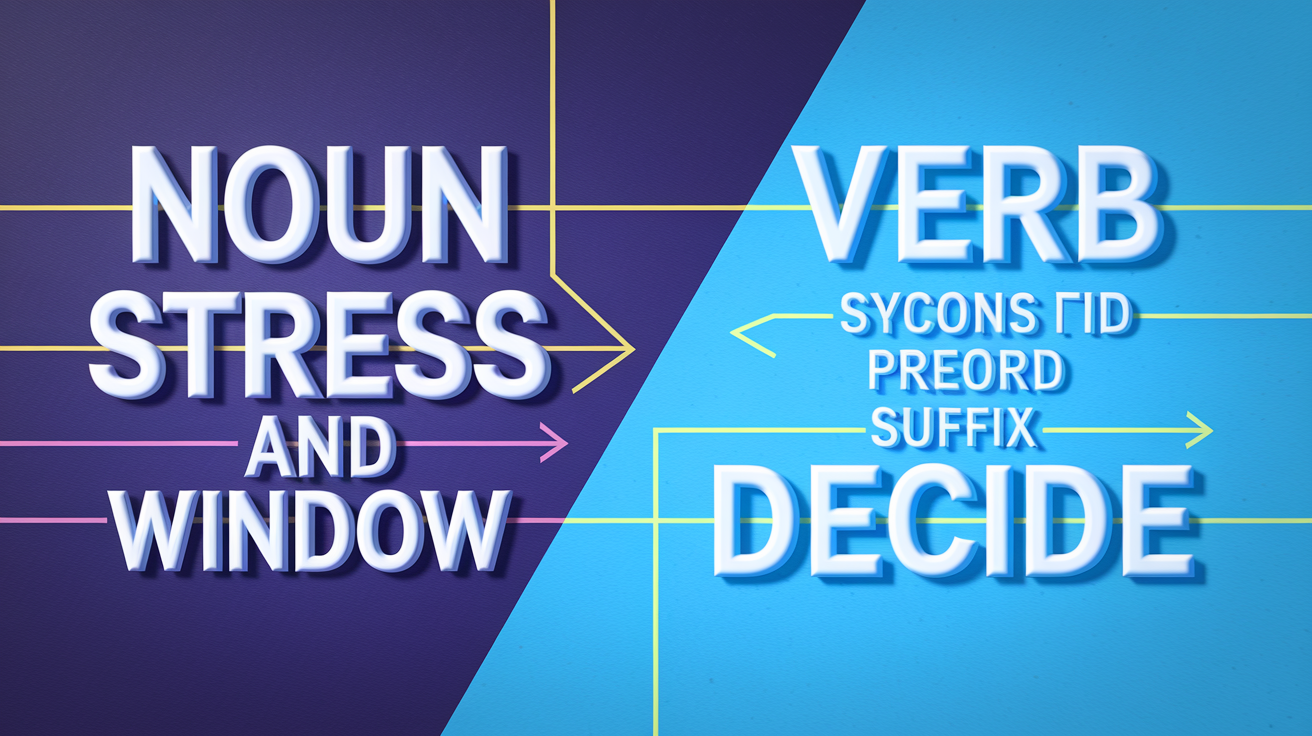
Two syllable nouns and adjectives in English usually place primary stress on the first syllable: “TAble,” “WINdow,” “HAPpy,” “SIMple.” Two syllable verbs often do the opposite, stressing the second syllable: “reLAX,” “proPOSE,” “deCIDE,” “arriVE.” This noun/verb distinction helps listeners predict word class before the sentence ends. When the same spelling functions as both noun and verb, stress alone differentiates meaning. “REcord” (noun) versus “reCORD” (verb), “PREsent” (noun/adjective) versus “preSENT” (verb), “CONduct” (noun) versus “conDUCT” (verb). Tracking these pairs trains your ear to hear stress as a grammatical signal, not just a rhythmic feature.
Prefixes and suffixes introduce systematic shifts. Prefixes like re, un, pre, and dis usually remain unstressed, leaving main stress on the root or a following syllable: “reTURN,” “unHAPpy,” “prePARE,” “disBELIEVE.” Suffixes vary. Ment, ness, ful, and less preserve root stress (“governMENT,” “HAPpiness”), while tion, ic, ity, and graphy pull stress to the syllable immediately before the suffix. “InforMAtion,” “ecoNOMic,” “electriciTY,” “phoTOGraphy.” Latin derived suffixes follow stricter rules. Greek derived patterns show more exceptions, so always verify unfamiliar academic or technical terms in a dictionary. Once you internalize these suffix behaviors, you can predict stress in thousands of derived words without memorization.
Compound words (two independent words joined into a single unit) nearly always stress the first element when the compound functions as a noun: “BLACKboard,” “SUNshine,” “FOOTball,” “BEDroom.” Phrasal combinations that remain separate words distribute stress differently depending on meaning: “a BLACK board” (any board that is black) versus “a BLACKboard” (the classroom object). Compound adjectives often stress the second element: “well KNOWN,” “old FASHioned,” though exceptions exist. Track these patterns by reading compound heavy passages aloud. Technical manuals, product descriptions, and children’s books all offer dense clusters of compounds. Mark where your natural emphasis falls.
Three example nouns with first syllable stress:
PICture /ˈpɪk.tʃɚ/
PROduct /ˈprɑː.dʌkt/
MUSic /ˈmjuː.zɪk/
Three example verbs with second syllable stress:
proDUCE /prəˈduːs/
reCORD /rɪˈkɔːrd/
beLIEVE /bɪˈliːv/
Practice Exercises for Tracking Stress in Words, Phrases, and Poetry
Structured drills build the muscle memory and auditory precision needed to track stress reliably. Start with single word exercises, then layer in phrase level and sentence level complexity. Each exercise should include a target task, a sample set, and a method for self checking your answers against a reference source. Repetition matters more than perfection. Track your progress weekly and notice which word types or patterns still trip you up. The exercises below move from simplest to most nuanced, so you can scaffold your skill gradually.
Six exercises to practice tracking stress patterns:
-
Mark stress on 10 sample multisyllabic words. Write out “banana,” “information,” “celebrate,” “understand,” “academic,” “recognize,” “capital,” “interrupt,” “development,” “photography.” Say each word aloud three times, clap or tap the syllables, and mark the stressed syllable with an accent or bold dot. Check your answers in an IPA dictionary. Repeat the list daily until you mark nine out of ten correctly without hesitation.
-
Record a short sentence and mark stress shifts. Record yourself saying “I didn’t recognize the address she gave me.” Play it back slowly and mark every syllable that sounds louder, higher, or longer. Notice how “didn’t,” “the,” and “she” lose prominence while “recognize,” “address,” and “gave” stand out. Compare your sentence recording to a text to speech version or a native speaker audio clip.
-
Compare two dictionary transcriptions. Look up the same word in American and British dictionaries (try “schedule,” “tomato,” “laboratory,” or “controversy”). Note differences in stress placement and vowel quality. Record yourself producing both variants and listen for which version matches your natural habit.
-
Scan a 2 line poem for metrical stress. Take two lines of iambic pentameter. “Shall I compare thee to a summer’s day? / Thou art more lovely and more temperate.” Mark the expected da DUM pattern. Read the lines aloud naturally and see where your spoken stress aligns with or diverges from the metrical expectation. Poetry often plays with stress to create emphasis or surprise.
-
Identify strong vs. weak function words. Write a list of ten function words: “the,” “a,” “to,” “of,” “and,” “in,” “for,” “with,” “at,” “on.” Say each in isolation (they’ll sound strong), then embed each in a short sentence. “The cat,” “a book,” “to go.” Notice how they weaken. Mark which context reduces the word to schwa and which context preserves a clear vowel.
-
Create a personal stress pattern journal. Choose five multisyllabic words each week from your reading, work vocabulary, or a word of the day list. Write each word, mark the stress, record yourself saying it, and note any surprises (e.g., “I thought the stress was on the first syllable, but the dictionary shows second syllable stress”). After four weeks, review your journal and identify recurring error patterns. Prefix confusion, suffix rules you missed, or dialect differences.
Differentiating Psychological Stress Tracking from Linguistic Stress Patterns

Physiological and psychological stress measurement tools (heart rate variability monitors, cortisol assays, and self report surveys like the Perceived Stress Scale) quantify the body’s response to demands, threats, and uncertainty. These instruments track autonomic nervous system activation, hormonal fluctuations, and subjective feelings of being overwhelmed or out of control. They answer questions like “How stressed am I today?” or “When does my body enter fight or flight mode?” None of these tools measure or care about which syllable in “photograph” receives prominence. The term “stress” in a psychological or medical context refers to a state of physiological arousal or perceived pressure, not to the rhythmic emphasis that organizes spoken language.
Linguistic stress serves an entirely different purpose. It structures rhythm, clarifies meaning, and guides listeners through the sound stream of English. Tracking linguistic stress helps you improve pronunciation intelligibility, teach English learners where to place emphasis, analyze poetic meter, and understand why “REcord” and “reCORD” mean different things. If you arrived here looking for cortisol tracking, HRV baselines, or perceived stress questionnaires, you’ll need resources focused on health monitoring and behavior change. If you want to mark syllables in a sonnet, coach a non native speaker, or understand why “CONduct” and “conDUCT” shift meaning with a simple stress swap, you’re in the right place.
Final Words
Start by listening and marking stressed syllables—pay attention to pitch, loudness, vowel length, and try clapping or tapping to feel the rhythm. Use IPA dictionaries and rhythmic scanning, then repeat the exercises until the patterns become clearer.
Zoom out to the bigger ideas: trochaic vs iambic tendencies, how prefixes and suffixes shift stress, and how dialects change things. Use recordings and spectrograms to check your ear.
Try this small test: mark five words, record yourself, and log what you hear—this is how to track stress patterns and you’ll see steady improvement.
FAQ
Q: What are the 5 A’s of stress management?
A: The 5 A’s of stress management are Avoid, Alter, Accept, Adapt, and Ask for support — simple steps to change stressors, shift your response, accept limits, try different coping moves, and reach out.
Q: What are the 4 types of stress?
A: The 4 types of stress are acute stress, episodic acute stress, chronic stress, and traumatic stress — ranging from short-term reactions to repeated spikes and long-term pressure that wears you down.
Q: How to determine stress pattern?
A: To determine a stress pattern, listen for higher pitch, louder volume, longer vowel length, and clearer vowels; check IPA stress marks in dictionaries, tap/clap for beats, annotate, and repeat practice.
Q: What are 7 warning signs of stress?
A: Seven warning signs of stress include irritability, trouble sleeping, persistent headaches, muscle tension, digestive upset, difficulty concentrating, and appetite changes — patterns worth noting and tracking for action.