



What if most stress advice actually makes you chase feelings instead of fixing what causes them? The faster way to real relief is to catch stress in the moment, note what happened, where your body tightened, and the first thought that showed up. Short, honest entries taken right after a stress spike, plus a quick pattern review over a few days, turn vague worry into clear triggers you can test and change. This post shows simple, proven methods: moment captures, micro-journaling, quick self-checks, and easy categorizing. They help you spot real triggers and try small fixes that add up to relief.
How to Identify Your Stress Triggers: Start Here

The fastest way to stop stress from controlling your day? Catch it in the moment and write it down. Most people try to remember stress triggers later, but memory smooths out details. It just does. Immediate identification exercises stop that fading. When you capture a stress spike as it happens, you see the real trigger instead of a blurry guess.
Short entries taken right after a stress episode give you more accurate information. Your heart rate’s still up. Your jaw’s still tight. The thought that sent your mind racing is still fresh. Writing down “boss email at 10:30 a.m., chest tightened, thought I’m about to get fired” takes thirty seconds and preserves the full picture. Wait until evening and you’ll remember the email but miss the body signal and the specific thought loop.
Consistency over several days reveals repeated stress patterns. One entry shows a moment. Three days of entries show a thread. When you notice “Monday 10:30 a.m. boss email, Tuesday 9:15 a.m. boss Teams message, Wednesday 11:00 a.m. boss meeting request,” the pattern becomes obvious. The trigger isn’t work in general. It’s communication from one person.
3-Step Stress Journaling Starter Exercise:
-
Capture the moment. As soon as you notice stress rising, jot down the time, what just happened, and your first physical sensation (tight chest, clenched jaw, racing heart).
-
Name the thought. Write the exact thought that appeared when stress spiked, even if it sounds extreme. “I’m going to get fired” or “They think I’m incompetent” or “I can’t handle this.”
-
Track for three days minimum. Repeat the same quick capture at every stress spike for at least three days, then review all entries to spot recurring times, people, tasks, or situations.
Recognizing Physical and Emotional Cues

Your body signals stress before your brain catches up. Physical cues like muscle tension, rapid heartbeat, and headaches often appear seconds before you consciously register stress. Emotional cues follow close behind. Irritability, sudden withdrawal, frustration that feels out of proportion. Early detection helps interrupt stress escalation. If you catch the tight shoulders or the jaw clench first, you can pause and name the trigger before your mood tanks or your day derails.
Most people recognize stress only after it’s already taken over. You snap at a coworker, then realize you’ve been tense for an hour. You get a headache and remember you skipped lunch and got three difficult emails back to back. Training yourself to notice early physical and emotional cues turns vague stress into specific, trackable triggers. Once you know sweaty palms mean “inbox overload” and a sinking stomach means “last minute meeting change,” you can address the real source instead of just feeling bad.
Common Physical and Emotional Cues to Track:
- Muscle tension in shoulders, neck, or jaw
- Racing or pounding heartbeat
- Shallow breathing or holding your breath
- Irritability that spikes suddenly during routine tasks
- Withdrawal from conversations or avoiding people you normally engage with
Pattern Analysis Techniques

Reviewing daily notes helps highlight recurring times, places, tasks, or people associated with stress spikes. One stressful morning might be random. Three Mondays in a row with stress spikes between 9:00 and 10:00 a.m.? That’s a pattern. Look for threads across multiple days instead of analyzing each entry in isolation.
Looking for patterns across multiple days gives clearer insights than same day reflection. When you review a full week of notes, certain names appear over and over. Certain times of day cluster. Certain types of tasks repeat. Open ended projects, tight deadlines, unclear instructions. These threads point to your actual triggers, not just bad moments.
Sort your notes by category to make patterns visible. Group entries by time of day, by person involved, by task type, or by location. You’ll see whether morning stress comes from email, whether afternoon stress comes from meetings, whether stress at home centers on one recurring issue. Patterns show you where to focus next.
| Time/Place/Trigger Type | Observed Reaction | Possible Root Cause |
|---|---|---|
| Monday 9:30 a.m., inbox, boss email | Heart racing, tight chest, thought “I’m in trouble” | Fear of criticism or job insecurity |
| Tuesday 12:45 p.m., desk, skipped lunch | Shaky hands, irritability, snapped at coworker | Low blood sugar and time pressure |
| Wednesday 4:00 p.m., home, partner raised voice | Jaw clenched, anger, shut down conversation | Feeling unheard or invalidated |
| Thursday 10:00 p.m., bedroom, scrolling news | Racing thoughts, can’t fall asleep, anxious | Overexposure to upsetting external events |
Categorizing Your Stress Triggers
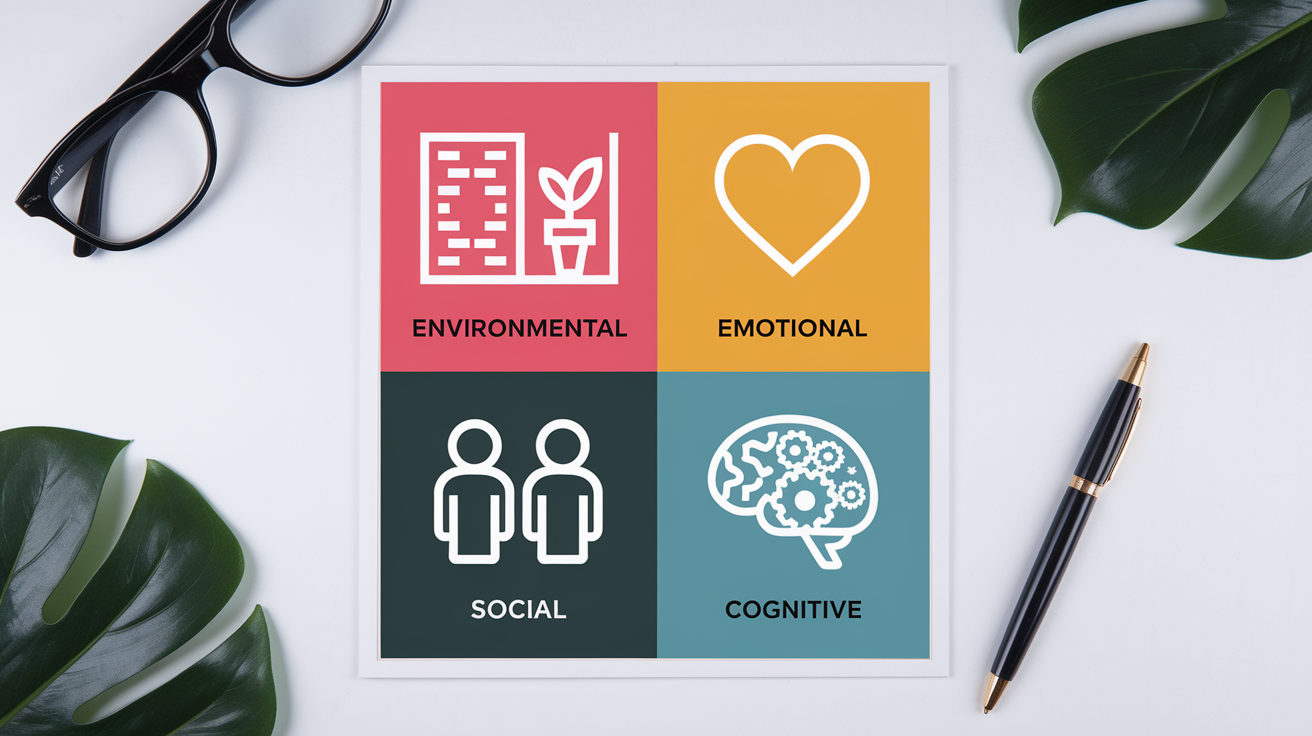
Common trigger categories include environmental, emotional, social, and cognitive. Environmental triggers are external. Noisy repairs, cluttered workspace, harsh lighting, long commutes. Emotional triggers are internal. Fear of failure, perfectionism, guilt, unresolved grief. Social triggers involve other people. Conflict with a partner, workplace demands, feeling unsupported. Cognitive triggers come from thought patterns. Harsh self talk, rumination, catastrophic thinking.
Categorization helps narrow down root causes and plan responses. If most of your triggers fall under “environmental,” you can adjust your space, schedule, or exposure. If they cluster under “cognitive,” you can work on thought patterns with journaling or therapy. When triggers span multiple categories, you see the full picture. Maybe stress at work is part environmental noise, part social conflict, part perfectionism.
Sort your week of stress notes into these four buckets. Write “E” for environmental, “Em” for emotional, “S” for social, “C” for cognitive next to each entry. Count how many fall into each category. If eight out of ten entries are tagged “S,” your stress is relationship driven. If most are “C,” your mind is the battlefield. Knowing the category tells you where to intervene first.
Common Trigger Categories:
- Environmental. Noise, clutter, temperature extremes, commute chaos, workspace layout, lighting, interruptions
- Emotional. Fear, shame, grief, perfectionism, self doubt, unresolved past experiences
- Social. Conflict with partner or family, workplace tension, feeling judged or misunderstood, lack of support
- Cognitive. Negative self talk, rumination, unrealistic expectations, mental replay of past mistakes
Using Self-Assessment Tools for Greater Accuracy

Self assessment tools can measure perceived stress levels, track frequency, and highlight hidden trigger areas. Structured questionnaires improve objectivity in identifying triggers. When you rate stress on a 0 to 10 scale every morning and evening, you catch patterns your memory would miss. When you answer the same set of questions daily (“Did I feel in control today?” “Did I avoid anyone?” “Did physical tension interfere with work?”), you build a dataset that reveals trends.
Short daily self assessments take two to three minutes and remove guesswork. You might feel like stress is “always bad,” but a week of 0 to 10 ratings shows stress was actually a 3 on Tuesday, a 7 on Wednesday, and a 9 on Thursday. That variation points to specific mid week triggers instead of a constant problem.
Pair self assessment scores with your journaling entries for deeper insight. If your stress rating jumps from 4 to 8 between morning and evening, check your journal for what happened during the day. The combination of a number and a narrative builds a complete picture. You see not only that stress spiked but also exactly when, where, and why.
Final Words
Start by jotting a quick note the next time stress hits. That immediate step, plus short post-stress entries, gives clearer recall and keeps things from feeling overwhelming.
Then scan those notes for repeat times, people, or tasks. Sort what you find into categories and use a simple self-check tool to sharpen your view.
Try these stress trigger identification methods for a week as a small experiment, then test one tiny change. You’ll likely feel more in control.
FAQ
Q: How to identify stress triggers?
A: Identifying stress triggers means noting what, when, and how you feel during stress: jot immediate post‑stress notes about situation, thoughts, body signs, and who was there. Review daily to spot repeating patterns.
Q: What is the 3 3 3 rule for stress?
A: The 3 3 3 rule for stress is a grounding trick: name 3 things you see, 3 sounds you hear, then move 3 parts of your body. It helps shift attention from panic to the present.
Q: What are 5 stress management strategies?
A: Five stress management strategies are: brief breathing breaks, quick walks or movement, short post‑stress journaling, setting small boundaries on tasks or messages, and prioritizing sleep and hydration.
Q: What are the 4 A’s of stress?
A: The 4 A’s of stress are Avoid, Alter, Adapt, and Accept — avoid unnecessary stressors, alter situations when you can, adapt your responses, and accept things you can’t change.