



Think your sleep needs shrink as you get older?
Many people say that, but waking more often doesn’t always mean you need less sleep.
Sleep tends to change in timing, depth, and how broken it feels, and the total hours often stay similar.
This guide walks through normal shifts from newborns to older adults, explains sleep-stage and circadian changes, and gives simple tracking steps you can try to spot patterns and decide what to adjust.
What Sleep Changes Are Normal at Each Stage of Life?
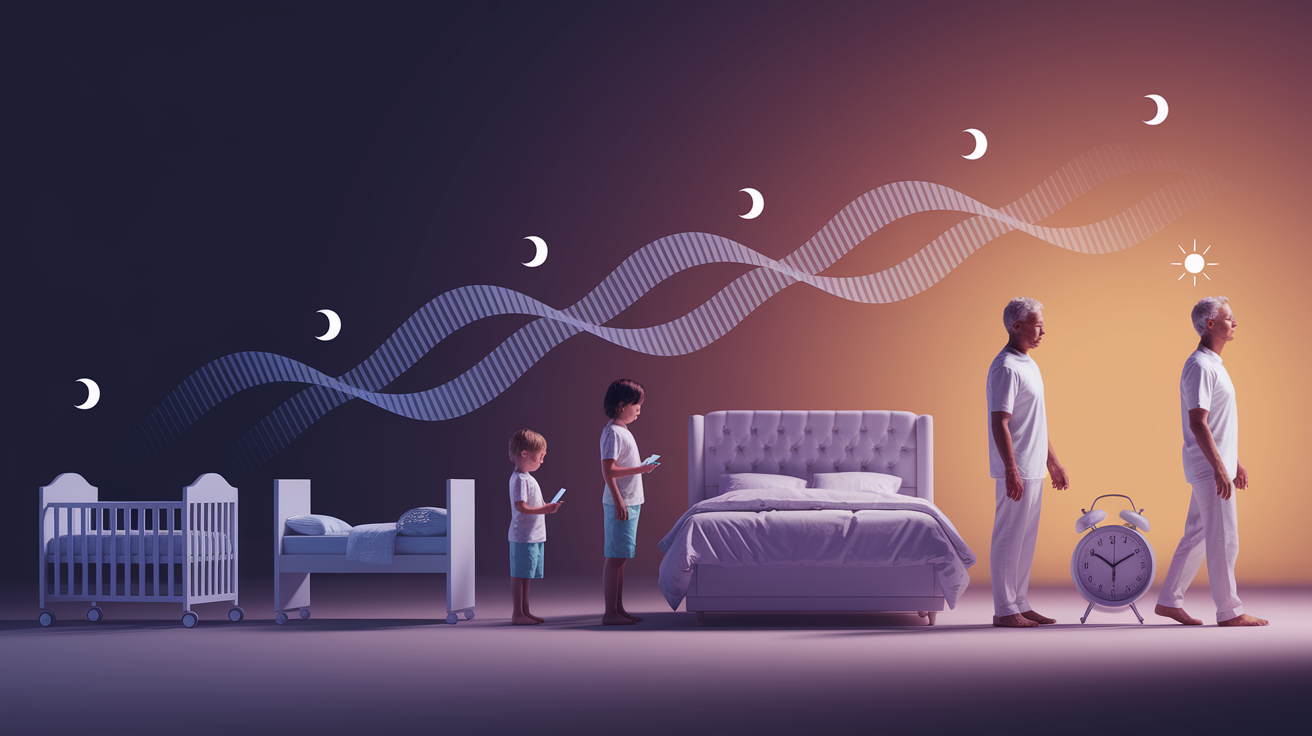
Sleep pattern changes are the natural shifts in how long we sleep, when we sleep, how many naps we take, how easily our sleep stays uninterrupted, and how our sleep stages are put together. It’s worth separating two things that often get mixed up: how much sleep your body actually needs, and how good you are at getting uninterrupted sleep. A person can wake up more often at 70 than they did at 30 and still need roughly the same total hours. Fragmented sleep doesn’t automatically mean your body has decided it needs less rest. Why sleep patterns change over time covers more on how these normal shifts unfold medically.
Zoom out across a full lifetime and a clear shape emerges. Newborn sleep is scattered across day and night in short bursts. Childhood sleep consolidates into longer, more predictable blocks. Adolescence brings a natural pull toward later bedtimes. Adulthood settles into a fairly stable need, even though life gets in the way of meeting it. Later in life, sleep tends to arrive earlier, feel lighter, and break up more easily, often with early morning waking that catches people off guard.
| Life Stage | Age Range | Recommended Sleep per 24 Hours | Typical Pattern |
|---|---|---|---|
| Newborns | 0-3 months | 14-17 hours | Polyphasic, frequent waking for feeding |
| Infants | 4-11 months | 12-15 hours | Sleep starts consolidating overnight |
| Toddlers | 1-2 years | 11-14 hours | Nap transition begins around age two |
| Preschoolers | 3-5 years | 10-13 hours | Naps fade, nighttime sleep dominates |
| School-age children | 6-13 years | 9-11 hours | Consolidated, consistent nighttime sleep |
| Teenagers | 14-17 years | 8-10 hours | Natural shift toward later bedtimes |
| Young adults | 18-25 years | 7-9 hours | Sleep need stabilizes, timing still flexible |
| Adults | 26-64 years | 7-9 hours | Stable need, often disrupted by work and family |
| Older adults | 65+ years | 7-8 hours | Earlier, lighter, more fragmented sleep |
How Sleep Architecture Changes With Age

Every night, your brain cycles through stages of NREM sleep (light and deep) and REM sleep, the stage where most vivid dreaming happens. In newborns, these cycles are quick, lasting only about 30 to 50 minutes each. By adulthood, cycles stretch out to roughly 90 to 110 minutes and repeat about four to five times a night. As the night goes on, REM periods tend to get longer, so the last REM stretch before waking is often much bigger than the first one.
The mix of these stages shifts dramatically over a lifetime. REM makes up around 50 percent of a newborn’s sleep, drops to about 30 percent by age one, and settles into roughly 20 to 25 percent in adulthood. Deep N3 sleep, the most physically restorative stage, is plentiful in childhood, often peaking around 20 to 25 percent of total sleep during childhood or young adulthood. That share can fall below 5 to 10 percent by age 70 or beyond. As REM and N3 shrink, N2, a lighter stage of NREM sleep, tends to fill in the gap.
Stacked-area chart specification:
- X-axis: newborn, age 1, age 10, age 25, age 50, age 70+
- Y-axis: percentage of total sleep
- Series: REM, N3/deep sleep, N2/light sleep
- Note: values are approximate ranges, not fixed numbers for every individual
Polysomnography, an overnight test that tracks brain waves, eye movement, and muscle activity, remains the clinical gold standard for measuring these sleep stages accurately. Consumer wearables try to estimate similar things, but they come with real limits worth understanding, something we’ll get into in the tracking section further down.
Circadian Rhythm Shifts From Childhood to Older Adulthood

Your circadian rhythm is your internal body clock, the system that decides when you feel sleepy and when you feel alert. It doesn’t stay fixed throughout life. It shifts in predictable directions during two major windows, adolescence and older adulthood, even though total sleep need stays fairly steady in between.
Childhood Chronotype Development
As infant sleep consolidates into longer nighttime blocks, a child’s internal clock matures alongside it. School schedules, family routines, and daily light exposure all help train this developing rhythm. Bedtime and wake time gradually become more predictable through the early childhood years.
The Adolescent Phase Delay
Puberty triggers a real biological delay in the body clock. Melatonin, the
Final Words
In the action, we defined sleep pattern changes as age-related shifts in duration, timing, naps, continuity, and sleep-stage mix. Important: needing the same amount of sleep is different from being able to sleep uninterrupted. Fragmented sleep doesn’t mean you need less.
We mapped the typical path — fragmented infant sleep, consolidated childhood sleep, later-timing teens, steady adult needs, and earlier, lighter sleep in later life. Tracking sleep pattern changes over time gives clues you can test with small steps. There’s usually something practical to try, and many people see steady improvement.
FAQ
Q: How many hours of sleep does a 70 year old need?
A: A 70-year-old typically needs about 7–8 hours of sleep per 24 hours. Waking more often or lighter sleep is common and doesn’t always mean you need less sleep.
Q: Why has my sleep pattern suddenly changed?
A: A sleep pattern can suddenly change because of stress, travel, new medications, illness, caffeine or alcohol, schedule shifts, caregiving, or hormonal changes; track timing and see a clinician if severe or persistent.
Q: What are the five types of sleep disorders?
A: The five key sleep disorders are chronic insomnia, obstructive sleep apnea, restless legs syndrome, circadian rhythm sleep-wake disorders, and neurodegenerative/REM-related sleep disruption (progressive fragmentation or dream enactment).
Q: What is the 3-3-3 rule for sleep?
A: The 3-3-3 rule for sleep is an informal parenting guideline whose exact meaning varies—often used to time newborn feedings, wake windows, or brief check intervals; consult the original source or a pediatric guide for specifics.