


Could the plant that flavors beer actually help you sleep—or is that just clever marketing?
Hops have been used for centuries as a calming plant when people feel wired at night.
Modern research hints at modest, repeatable effects for some people, mostly by easing pre-sleep tension and helping you fall asleep a bit sooner.
Thesis: hops for sleep can offer mild, testable support as part of a bedtime routine, not a guaranteed cure for chronic insomnia.
Try it for a few nights, track what changes, and check with a clinician if problems persist.
The Bottom Line On Nighttime Use
Hops, the same plant that gives beer its bitter edge, have a much older job as a calming herbal remedy. Long before they flavored a pint, people used them as a traditional nervine, a plant meant to settle a restless nervous system. For generations, folks have turned to humulus lupulus when they felt wired at night, jumpy, or stuck staring at the ceiling instead of sleeping.
So does it actually work? Here’s the honest answer. Hops for sleep may offer modest support. Nothing dramatic, but real enough that it’s worth trying for some people. It might help you unwind before bed and ease into sleep a bit easier. What it isn’t, though, is a proven standalone fix for chronic insomnia. The human evidence for hops on its own is still pretty thin.
Here’s what matters most:
- Hops may bring a mild calming effect that helps you relax before bed.
- They may support falling asleep and staying asleep, though solid hops-only research in humans is limited.
- Talk to a qualified healthcare professional before starting, especially if you take medication or manage a health condition.
- If insomnia is severe, persistent, or keeps coming back, that calls for a medical evaluation, not a self-directed herbal fix.
How Hops Affect Sleep-Related Pathways

To understand why hops might help you wind down, it helps to know about GABA. GABA is one of the brain’s main calming chemicals. It’s the signal that tells your nervous system to quiet down and get ready for rest. When GABA activity increases, neural firing slows, muscles loosen up, and that restless mental chatter tends to fade. This is the pathway researchers point to when they talk about hops and sleep. It’s a proposed mechanism, not a guaranteed outcome, and it’s worth being clear this doesn’t mean hops act just like a prescription sedative. The pathway may overlap, but the strength and reliability of the effect is a different story altogether.
Several compound groups in hops are thought to play a role here:
- Alpha and beta acids, including humulone and lupulone, tied to much of the plant’s bitter character and biological activity.
- Xanthohumol and other hop-derived polyphenols, compounds getting attention for their broader effects on the body.
- Volatile or bitter-resin components, including 2-methyl-3-buten-2-ol, a breakdown product some researchers link to sedative activity.
- Sesquiterpenoids, diterpenoids, triterpenoids, and phytoestrogenic constituents, a mix of plant compounds associated with hops’ overall biological profile.
Beyond GABA, researchers have looked at whether hops might touch other sleep-related systems too, including serotonin and melatonin, both tied to mood and your internal body clock. There’s also interest in circadian regulation (your natural sleep-wake rhythm), general movement during sleep, and body temperature, which naturally dips as you drift off.
Here’s the tricky part. Much of this comes from animal research, useful for understanding what might be happening at a biological level, but it can’t really tell us how reliably hops work for a tired human trying to fall asleep at 11 p.m. The mechanisms are plausible. Proof in people is a separate question entirely.
Scientific Evidence Behind Hops For Sleep
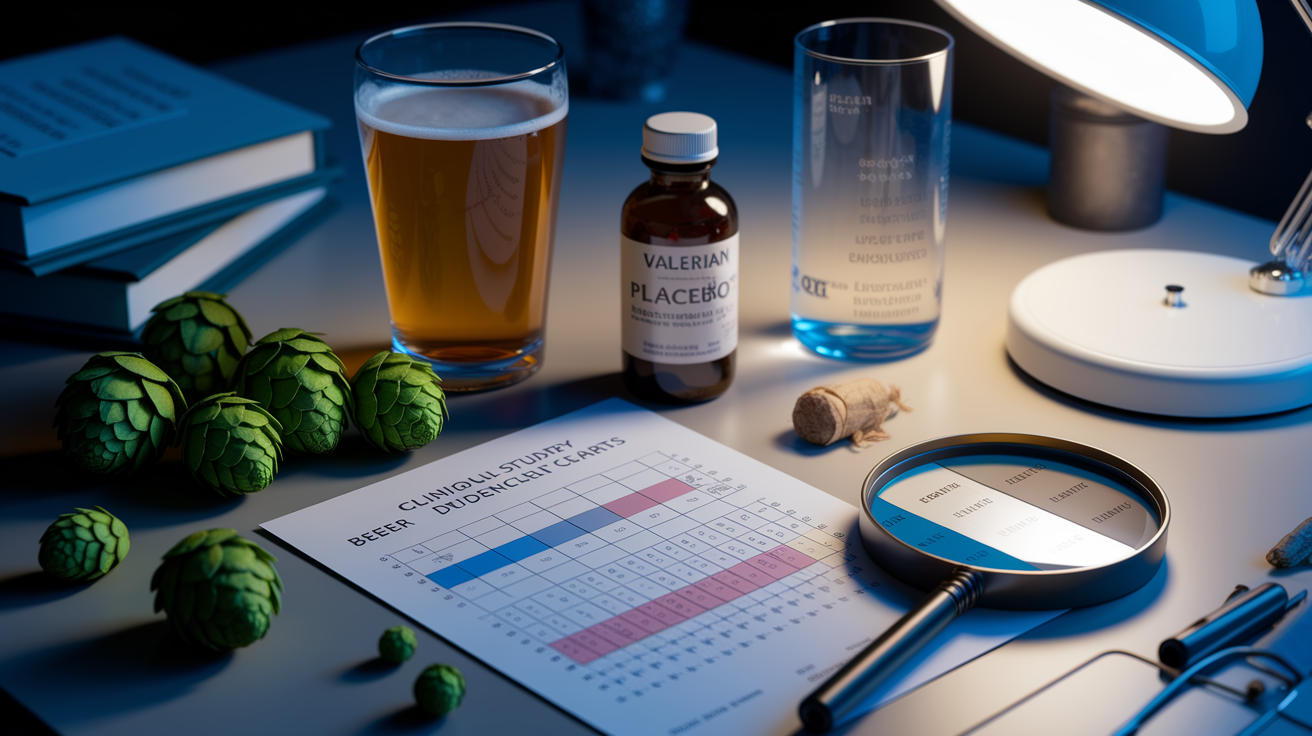
Research on hops for sleep falls into three distinct buckets, and mixing them together gives a misleading picture. There’s hops-only human research, there’s hops combined with valerian (another calming herb) in human trials, and there’s animal research. Combination studies are especially tricky since any benefit could come from the valerian, the hops, or both working together. Here’s how the evidence breaks down.
| Evidence Category | Year | Study Or Sample | Dose And Intervention | Comparison | Reported Finding | Key Limitation |
|---|---|---|---|---|---|---|
| Hops-focused human research | 2017 | Randomized placebo-controlled crossover pilot study | Daily hops dry extract for four weeks | Placebo | Decreased anxiety, depression, and stress | Did not directly measure insomnia treatment effect |
| Hops-focused human research | Not reported | 17-participant trial | 333 mL hops-containing non-alcoholic beer | Placebo | Improved sleep quality, reduced sleep latency | Small sample size |
| Hops-focused human research | 2012 | Night-shift nurses | Non-alcoholic beer | Not reported | Improved sleep quality | Specific population, not generalizable |
| Combination-formula review | 2010 | Review of 16 studies | Hops-containing formulas, ingredients vary | Not reported | 12 of 16 studies reported sleep improvements | Formulas contained additional ingredients beyond hops |
| Hops-and-valerian trial | 2007 | Not reported | 120 mg hops with 500 mg valerian | Placebo | Reduced sleep latency | Effect of hops alone not isolated |
| Hops-and-valerian trial | 2005 | 184 participants |
Final WordsHops are the same plant used in brewing and a traditional calming herb. They may modestly help you relax, fall asleep, and stay asleep, but evidence for hops alone is limited. We covered how hops might act on calming brain pathways, the human and animal evidence, and practical options like tea, extracts, or pillows. Try a small, trackable test and keep notes. If you try hops for sleep, treat it as a gentle experiment and check suitability first. FAQQ: Are hops good for sleeping?A: Hops are a brewing plant long used as a calming herb; they may modestly help relaxation, falling asleep, and nighttime sleep, but human evidence for hops alone is limited. Q: What is the strongest natural sleep aid?A: There isn’t a single strongest natural sleep aid; options often tried include melatonin, valerian, and herbal blends, but effectiveness varies by person—test small changes and consult a provider if sleep stays poor. Q: Who should not take hops extract, and does hops act like estrogen?A: People who should not take hops extract include those with hormone-sensitive conditions, because hops contain plant compounds with estrogen-like activity; pregnant or breastfeeding people and anyone on hormone or sedative medications should check with a clinician.  Subscribe for exclusive contentOn Sleep Health Wellness and More, Copyright - All Rights Reserved - 2026 |