


Sleep isn’t one thing — it’s a repeating journey your brain takes each night.
You move through light drowsy moments, steadier sleep, deep slow-wave rest, and dream-rich REM in a pattern that repeats four to six times.
Each stage has a clear brain and body fingerprint: different waves, eye movements, and muscle tone.
This post shows what each stage looks like, how long it lasts, and the simple signs you can track to spot patterns and test small fixes that may help your sleep.
Sleep Stages at a Glance: Timing, Brain Activity, and Body Changes
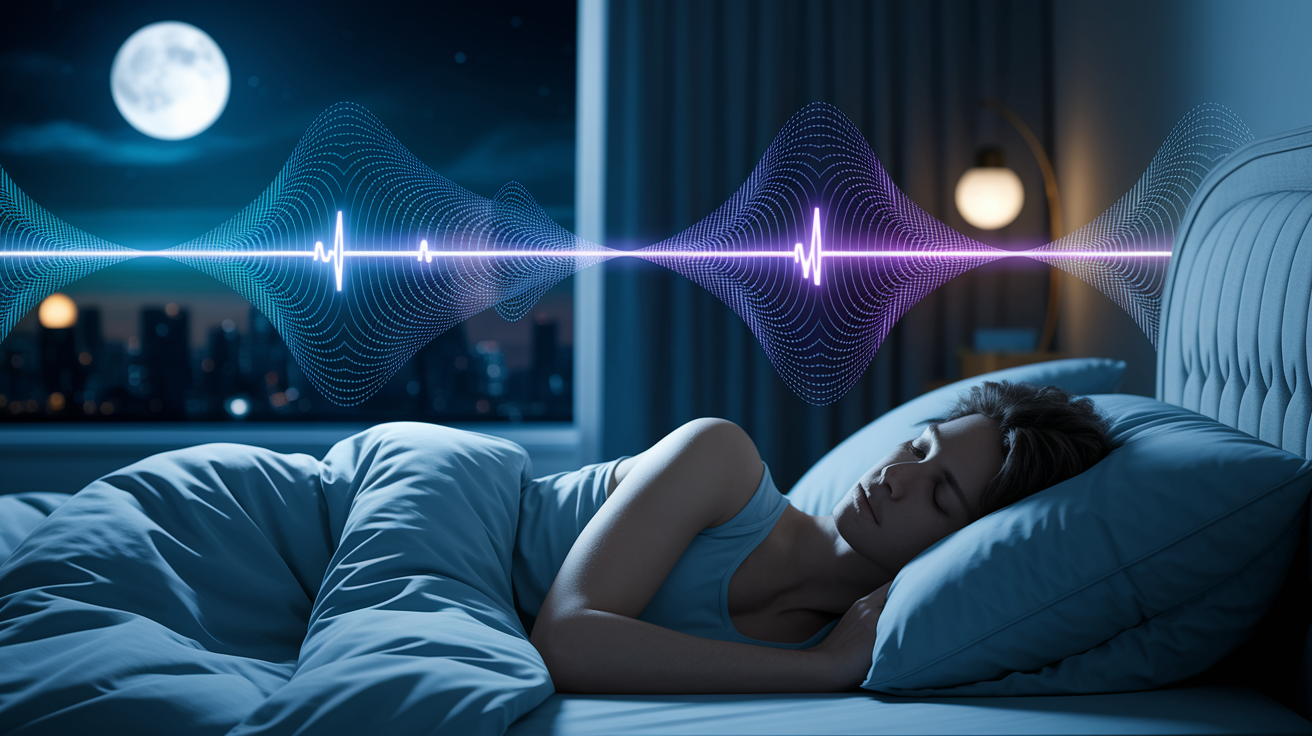
Sleep architecture is the repeating pattern of NREM and REM sleep that plays out across your night. It’s made up of three NREM stages, N1, N2, and N3, plus REM sleep, all lined up in a fairly predictable order. Most adults cycle through this sequence 4 to 6 times per night, with each round lasting somewhere around 90 to 120 minutes.
If you’ve read about sleep stages before, you might remember four NREM stages instead of three. That’s the old model. Current classification, as outlined by the Sleep Foundation, merges the former stages 3 and 4 into one deep sleep stage called N3.
| Stage | Typical Share of Adult Sleep | Approximate Duration | Brain Activity | Main Physical Characteristics |
|---|---|---|---|---|
| N1 | 2-8% | About 1-7 minutes | Theta activity around 4-7 Hz | Slow eye movements, easy to wake up |
| N2 | 45-55% | About 10-25 minutes in early cycles | Sleep spindles and K-complexes | Slower heart rate, regular breathing, dropping body temperature |
| N3 | 13-23% in young adults | About 20-40 minutes in early cycles | High amplitude delta waves below 4 Hz | Deepest sleep, lowest metabolic activity |
| REM | 20-25% | About 10 minutes at first, 20-60 minutes later | Low voltage, mixed frequency EEG | Rapid eye movements, irregular breathing, vivid dreams, muscle atonia |
How Brain and Body Signals Distinguish Each Sleep Stage

Sleep stages don’t get labeled by how “deep” they feel. They’re identified by combining three signals: brain wave patterns from an EEG, eye movement, and muscle tone. Put those three together and you get a fingerprint unique to each stage.
Stage N1: Crossing the Boundary From Wakefulness
N1 is the doorway into sleep, and you can actually watch it happen on an EEG. The relaxed alpha waves of quiet wakefulness fade out, and theta activity starts taking over. Subjectively, this often feels like your thoughts drifting apart, awareness slipping in and out, or that falling sensation that sometimes ends with a sudden jolt, known as a hypnic jerk. Slow, rolling eye movements show up here too. What really separates N1 from being awake, or from deeper sleep, is that you’re still pretty easy to rouse. Say someone’s name softly and they might respond, even if they don’t remember it later.
Stage N2: Recognizable Markers of Stable Sleep
N2 has two calling cards: sleep spindles and K-complexes. These show up as brief bursts riding on top of ongoing theta activity, and they’re what scorers look for to confirm you’ve settled into N2. Spindles are tied to thalamocortical activity, basically communication between deep brain structures and the outer brain layer, and they seem to help block outside sensory information from reaching conscious awareness. K-complexes can pop up on their own or in response to a sound or touch, and they may actually help protect sleep by suppressing arousal. Meanwhile your autonomic system, heart rate, breathing, temperature, starts settling into a steadier rhythm.
Stage N3: Delta Activity and High Arousal Thresholds
N3 is defined by big, slow delta waves, a sign that large groups of cortical neurons are firing in sync. This widespread synchronization is part of why N3 is the hardest stage to wake someone from, and why people often feel groggy or confused when woken suddenly during it. Autonomic and metabolic processes slow even further here. This is also the stage most linked to unusual nighttime events like sleepwalking, sleep terrors, and confusional arousals, since the brain stays only partially responsive even when the body moves.
REM: Wake Like EEG With Muscle Atonia
REM is the stage that trips most people up, because the brain wave pattern looks a lot like being awake, low voltage, mixed frequencies. What gives it away are the rapid eye movements and a near total drop in chin muscle tone. Brainstem circuits actively suppress most skeletal muscle activity during REM, while sparing the diaphragm so you keep breathing, and the eye muscles so your eyes can dart around. Heart rate and breathing tend to get irregular here, reflecting a burst of autonomic activation. When that muscle suppression doesn’t work properly, it can lead to REM behavior disorder, where people physically act out dreams instead of staying still.
How Sleep Cycles Progress Across an Eight Hour Night

A typical night, as described by Harvard Health when defining sleep architecture, follows a fairly recognizable path. You move from wakefulness into N1, then N2, then down into N3, before climbing back up through lighter sleep and into REM. It’s not always a straight line though. Brief awakenings are common and normal, even if you don’t remember them come morning.
The first cycle tends to run shorter, often somewhere between 70 and 100 minutes, while cycles later in the night stretch out longer.
Final Words
You can now trace how N1, N2, N3, and REM cycle through the night, and how EEG, eye movement, and muscle tone mark each stage across about 4–6 cycles. We showed what a hypnogram looks like, why deep N3 and REM matter, and which things commonly fragment sleep.
If your nights look different, treat that as a clue: try steady bedtimes, skip late caffeine and alcohol, and make the bedroom cool and quiet for two weeks.
Track changes, watch how your sleep architecture stages respond, and bring patterns to your clinician if needed.
FAQ
Q: What is the 3-3-3 rule for sleep?
A: The 3-3-3 rule for sleep is an informal shortcut, not a universal standard; different people use it for wind-down, nap timing, or screen and food timing—check the source for the exact meaning.
Q: Which sleep cycle is worst to wake up in?
A: Waking from deep sleep (stage N3) is usually worst, because strong delta activity makes you groggy, slow to think, and disoriented for several minutes.
Q: Is it better to be in REM or deep sleep?
A: Whether REM or deep sleep is better depends on the function: deep sleep (N3) aids physical recovery and memory consolidation, while REM supports emotion, learning, and vivid dreaming—both matter.
Q: What are the 5 stages of sleep psychology?
A: The five-stage model lists stages 1, 2, 3, 4 (NREM) and REM; modern classification combines stages 3 and 4 into a single N3 slow-wave stage, so current models use four categories.