



What if your push to train harder is actually making you worse?
Overtraining often starts small, for example sore, foggy, or slower, but the clues pile up across body, mood, and performance so people miss them.
Timing is the key.
Normal tiredness clears in 24 to 72 hours, but overtraining doesn’t.
This post gives a short symptom checklist, the early signs to track like resting heart rate, sleep, and mood, and simple first steps you can try today to see if you’re heading toward real fatigue.
Symptom Checklist for Overtraining Fatigue
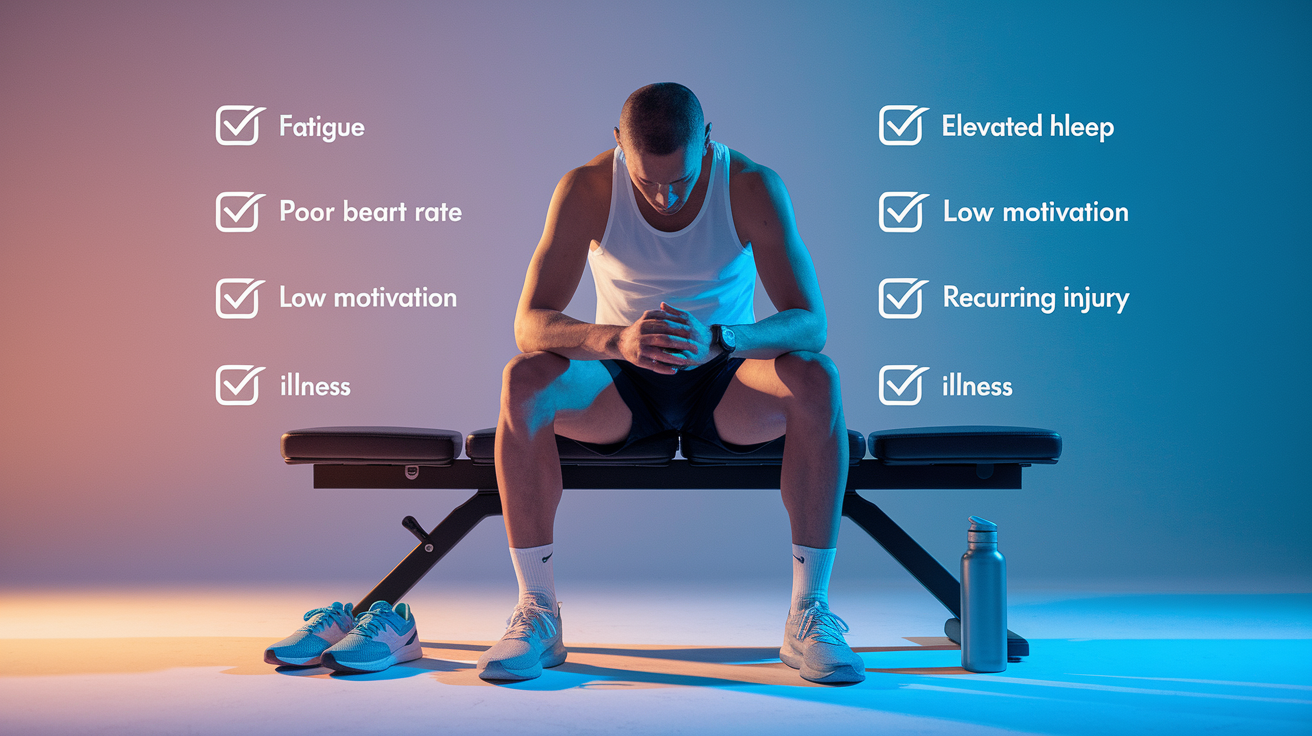
Recognizing overtraining fatigue starts with knowing what to look for, and it rarely shows up as just one thing. Symptoms tend to stack up across a few categories at once: physical, mental, and performance based. That’s exactly why so many people miss the early signs until it’s already a bigger problem. Here’s a quick checklist to run through before we get into the details.
- Persistent performance decline despite adequate rest (the hallmark sign)
- Fatigue that lingers beyond 72 hours after a workout
- Symptoms that stick around for two or more weeks
- Elevated resting heart rate compared to your normal baseline
- Reduced heart rate variability (HRV)
- Mood changes like irritability, apathy, or low motivation
- Poor or shallow sleep quality
- Recurrent illness or nagging injuries that won’t heal
So how do you know if this is just a hard week or actual overtraining fatigue? Timing is the key clue. Normal, acute fatigue after a tough session usually resolves within 24 to 72 hours. Your legs feel heavy for a day or two, then you’re back to normal. Functional overreaching goes a step further, causing a performance dip that lasts anywhere from a few days to two weeks, but it’s usually followed by a rebound (sometimes called supercompensation) once you back off. True chronic training fatigue, or overtraining syndrome, is different. It persists for two or more weeks and can drag on for months if it’s not addressed, and rest alone often doesn’t fix it the way it would with normal fatigue.
What To Do Now
- Cut back training volume and intensity right away, don’t wait for things to “just improve”
- Prioritize sleep and eating enough, especially carbs and protein
- See a doctor if symptoms feel severe or haven’t improved after two weeks
Physical Signs of Overtraining Fatigue

Physical signs of overtraining are usually the easiest to measure, which makes them a solid starting point when you’re trying to figure out if what you’re feeling is normal tiredness or something more. These build directly on the checklist above, but with more specific numbers attached.
- Fatigue that doesn’t ease up with normal rest, staying heavy for days instead of hours
- Persistent muscle soreness lasting beyond 72 hours, well past the usual recovery window
- Elevated resting heart rate, typically 5 to 10 beats per minute above your normal baseline, sustained over three or more mornings
- Reduced heart rate variability (HRV), often dropping by around 10 percent or more over several days
- Decreased strength or an inability to hit your usual weights and paces for more than a week
- Increased frequency of colds or infections, a sign your immune system is under strain
- Recurring overuse injuries, like shin splints or jumper’s knee, that keep showing up in the same spots
These physical markers tend to show up early. They’re also the most objective, which is what makes them so useful. Feelings can be hard to trust some days, but a resting heart rate that’s stubbornly 8 beats higher than usual for a week straight is hard to argue with.
If you’ve got a fitness tracker, or even just a habit of checking your pulse each morning, logging these numbers consistently can help you spot the difference between a genuinely rough patch and a pattern worth addressing. One bad night of sleep doesn’t mean much. Ten days of elevated resting heart rate paired with soreness that won’t quit? That’s a pattern.
Mental and Behavioral Signs of Overtraining Fatigue

Mental fatigue and mood changes often show up quietly, sometimes even before the physical signs become obvious. It’s easy to write off irritability or low motivation as “just a busy week.” But when these feelings show up alongside the physical markers we just covered, they’re worth paying closer attention to. Athlete burnout, sometimes called staleness syndrome, shares a lot of overlap with overtraining here. Both involve a kind of emotional exhaustion and a growing sense of detachment from a sport or routine you used to enjoy.
- Increased irritability or a shorter fuse than usual
- Loss of motivation to train, even for sessions you normally look forward to
- Poor concentration, both during workouts and in daily tasks
- Rising perceived exertion, meaning a workout that used to feel like a 6 out of 10 now feels like an 8 or 9 for the same effort
- Emotional flatness or apathy, a sense of just going through the motions
These signs are more subjective than resting heart rate or HRV, sure. But they’re just as real, and honestly, they’re often what people notice first. A simple daily rating, jotting down your mood or motivation on a scale of 1 to 10, can turn a vague feeling into a trackable pattern. Pair that with the physical metrics from the last section, and you start to get a much clearer picture of what’s actually going on.
Performance-Related Signs of Overtraining Fatigue

Performance decline despite training is often the clue that ties everything else together. This is the frustrating part for a lot of people. You’re putting in the work, maybe even more than usual, but your times are getting slower, your lifts feel heavier, and progress has flat lined or gone backward. That mismatch between effort and results is a strong signal something’s off.
Reduced endurance capacity is one of the more obvious versions of this. Runs that used to feel manageable at a certain pace suddenly feel like a grind, and you’re gassed out earlier than you should be. Strength loss shows a similar pattern in the gym. Weights that were routine a few weeks ago now feel unusually heavy, or you’re missing reps you’d normally complete without much thought.
Here’s the tricky part: this isn’t just about slacking off or having an off day. Workload mismanagement, meaning too much volume, too little recovery, or both, is usually the root cause. Your body hasn’t had the chance to adapt and rebuild between sessions, so instead of getting stronger or faster, you’re stuck treading water or sliding backward.
What makes this signal so useful is that it’s easy to track. If you’re already logging your workouts (times, weights, reps), a performance drop of around 5 percent or more across two or three sessions is worth paying attention to.
Final Words
Spot the patterns now. A steady drop in performance despite rest, soreness past 72 hours, poor sleep, or a resting heart rate that stays several beats higher are the immediate clues we covered.
Try small experiments: cut training volume 10 to 20 percent, prioritize sleep and carbs/protein, and track resting heart rate, HRV, and daily motivation for a week.
If you want to know how to recognize overtraining fatigue signs, use this checklist and those quick tests. If nothing improves, see a clinician. Small, steady changes usually bring progress.
FAQ
Q: What does overtraining fatigue feel like?
A: Overtraining fatigue feels like persistent heavy tiredness that doesn’t lift with rest, “wired but tired” sleep, foggy thinking, loss of power or endurance, mood swings, frequent colds, and longer muscle soreness.
Q: How long does overtraining fatigue last?
A: Overtraining fatigue lasts longer than normal recovery: regular workout tiredness clears in 24–72 hours; functional overreaching lasts days to two weeks; true overtraining syndrome tends to persist two weeks to several months if unaddressed.
Q: What are 10 signs that I might be overtraining?
A: The 10 signs that you might be overtraining are persistent performance decline, fatigue lasting more than 72 hours, symptoms persisting two or more weeks, elevated resting heart rate, reduced HRV, irritability, poor sleep, frequent illness, prolonged soreness, recurring injuries.
Q: What are the symptoms of Stage 1 overtraining syndrome?
A: The symptoms of Stage 1 overtraining syndrome are a mild but persistent performance dip, longer-than-usual soreness, increased perceived effort, low motivation or enjoyment, subtle sleep changes, and small rises in resting heart rate or lower HRV.