



Is your research list pretending different kinds of things are the same?
This happens when particle names, measurement units, and engineering applications all get tossed together under “physics” or “energy.”
Those words match on the surface, but not in meaning.
An electron, a joule, and a power grid play different roles.
The good news is you can fix it without rewriting everything.
Classify each entry by what it actually is: entity, property, or process. Tag its domain and scale. Then build clear crosswalks so terms connect only where they truly belong.
How to Correct a Mixed Research Vocabulary

Your instinct here is right. The research list really does contain a genuine categorical mismatch, even though every entry might technically fall under the broad umbrella of physics and engineering. It’s not a false alarm. It’s not you misreading things.
Here’s the thing though. These entries represent different types of concepts entirely. A particle isn’t the same kind of thing as a measurement unit, and a measurement unit isn’t the same kind of thing as an application or a process. Treating them as interchangeable keywords is where the trouble starts, because they were never meant to sit in the same bucket in the first place.
The fix is simpler than it might feel right now. Classify every entry by what kind of concept it actually is, separate the pieces that belong together, then build clear mappings for any relationships between domains that are genuinely valid. That’s it. You’re not throwing anything away, you’re just giving each piece its correct label.
| Mismatch Signal | Why It Matters | Immediate Action | Desired Result |
|---|---|---|---|
| Mixed concept types (entities, properties, processes lumped together) | An electron and its energy are not the same kind of thing, so grouping them hides real distinctions | Tag each entry as entity, property, process, or measurement | Entries sorted by what they actually are, not just shared vocabulary |
| Mixed domains (particle physics next to power engineering) | Shared words like energy or resistance mean different things in each field | Assign a primary domain tag to every record | Clear separation between physics research and engineering application |
| Missing context (no scale, unit, or condition noted) | Without scale or unit, a term can’t be reliably classified | Add scale metadata such as temperature, length, or frequency | Every entry carries enough context to be classified with confidence |
| Unsupported cross-domain relationships | Implying a lab result proves a grid-scale claim overstates the evidence | Replace assumed links with explicit, evidence-based mappings | Only genuine interdisciplinary connections remain, clearly labeled |
Why Physics Terminology and Electrical Energy Vocabulary Become Misaligned

A lot of this comes down to one thing: broad words get used differently depending on who’s talking. “Electricity” might mean charge carriers in one sentence, charge flow in the next, and electromagnetic energy right after that. Physics does something similar with “matter.” It can mean ordinary atomic material, elementary particles, or non-relativistic particles depending on whether you’re in a chemistry classroom or a cosmology lecture. None of these usages are wrong exactly. They’re just not the same thing, and that’s where research lists start to blur together.
It helps to separate entities from properties and quantities early on. Electrons are things, particles with charge and mass and energy. Photons are also things, quanta of the electromagnetic field, and they carry energy according to E = hν. Energy itself isn’t a thing at all. It’s a property that things can have, the same way weight is a property of an apple rather than a type of fruit. Current and power follow the same pattern. Current measures how fast charge moves, and power measures how fast energy transfers. Related ideas, sure, but not swappable ones. For a deeper look at why this distinction matters so much, “Matter and Energy: A False Dichotomy” walks through why these categories keep getting confused.
Semantic drift plays a role too. Titles, abstracts, and outreach summaries tend to use plain, accessible language, “electricity powers your home,” while the actual formulas and methods buried in the paper use much more precise terminology. That gap between the friendly headline and the technical guts of the work is often where confusion creeps into a research list. Someone skims the summary, tags it based on the easy words, and the precise meaning gets lost along the way.
Automated indexing makes this worse, not better, a lot of the time. A system built to spot shared vocabulary will happily merge a quantum physics paper with a power-grid engineering report if both mention “energy loss” or “resistance,” even though the two are talking about completely different phenomena at completely different scales. The words match. The meaning doesn’t.
And that brings up the scale problem, which might be the trickiest piece of all. A microscopic quantum result, say, something observed in ultracold atoms sitting near absolute zero, cannot support a claim about grid-scale conductors without a lot of connective tissue in between. You’d need evidence linking material behavior, temperature range, physical length, current density, and real operating conditions. Skipping that step and jumping straight from lab bench to power line is exactly the kind of leap that creates a fundamental mismatch in a research list.
Classify the Research List and Build a Semantic Crosswalk
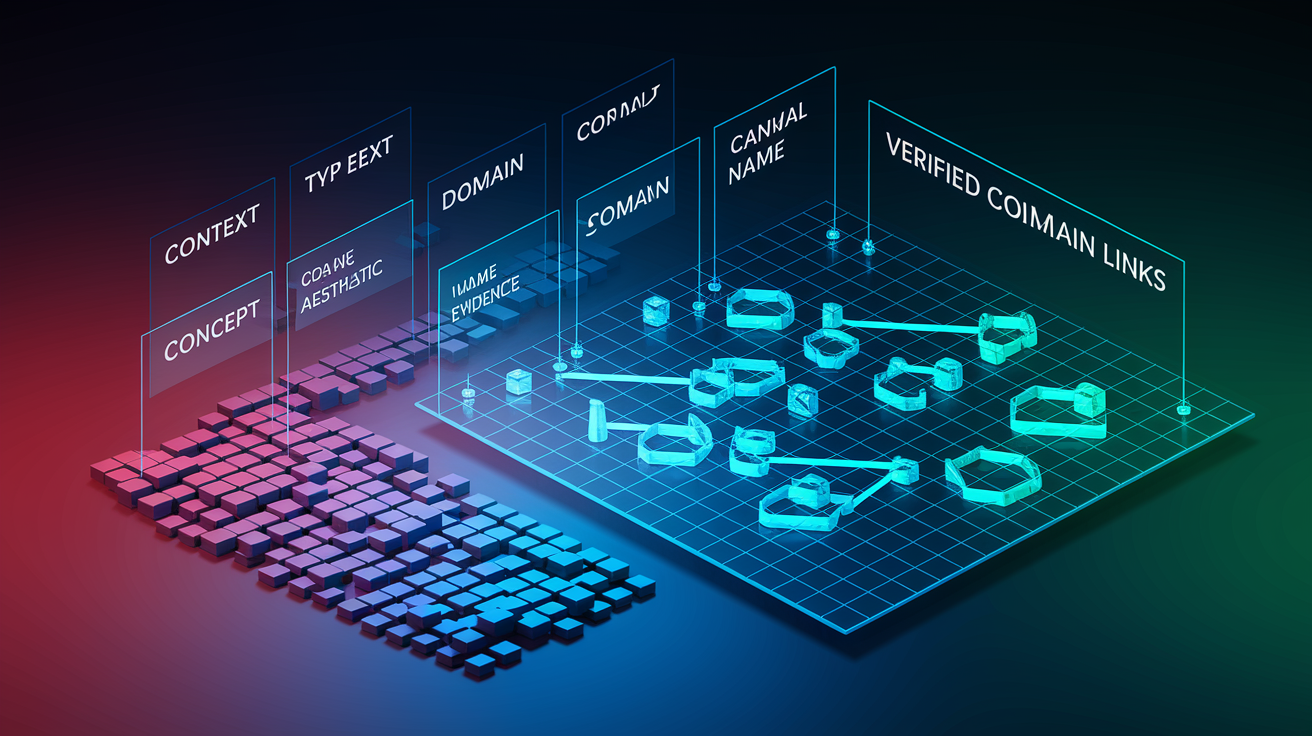
Before you can fix a mismatched list, you need to see it clearly first. That means going record by record and capturing each term in its original context, not just pulling out the word itself but noting the sentence, formula, or metadata field it came from. Context is what tells you what a word is actually doing.
From there, the workflow moves in a fairly natural sequence: capture the source term, classify the concept, tag the domain and scale, assign a canonical name, and finally, decide what cross-links are actually justified. Skipping steps here tends to reintroduce the same confusion you’re trying to clear up.
- Record the original term and the sentence, abstract, formula, or metadata field in which it appears.
- Identify whether it names an entity, property, process, measurement, carrier, medium, phenomenon, or application.
- Assign its primary domain and any justified secondary domain.
- Inspect units, formulas, methods, instruments, materials, and operating conditions for classification evidence.
Final Words
The research list contains a genuine categorical mismatch: physics and electrical energy terms are mixed together and can’t be treated as interchangeable. That makes search results noisy and claims risky.
Fix it by classifying every entry by concept type and domain, separating coherent groups, and creating explicit cross-domain mappings. Then run manual and machine-assisted checks and adopt controlled vocabulary rules.
Do this cleanup, and you’ll turn cluttered results into clear, testable links. You can resolve this fundamental mismatch and keep future lists cleaner.
FAQ
Q: What are the 7 biggest unanswered questions in physics?
A: The seven biggest unanswered questions in physics are dark matter, dark energy, quantum gravity, matter–antimatter asymmetry, neutrino masses, the hierarchy problem, and the origin and nature of time.
Q: What is the holy grail of physics?
A: The holy grail of physics is a single theory that unites general relativity with quantum mechanics, explaining gravity and quantum behavior together and making testable predictions across scales.
Q: Which is better, physics or electrical engineering?
A: Choosing between physics and electrical engineering depends on your goals: physics for deep theory and research, electrical engineering for hands-on design, product development, and industry careers.
Q: What is the most common misconception about electricity?
A: The most common misconception about electricity is that electrons carry energy like packets down a wire; actually energy moves via electromagnetic fields, while electrons drift slowly and mostly oscillate in AC systems.