
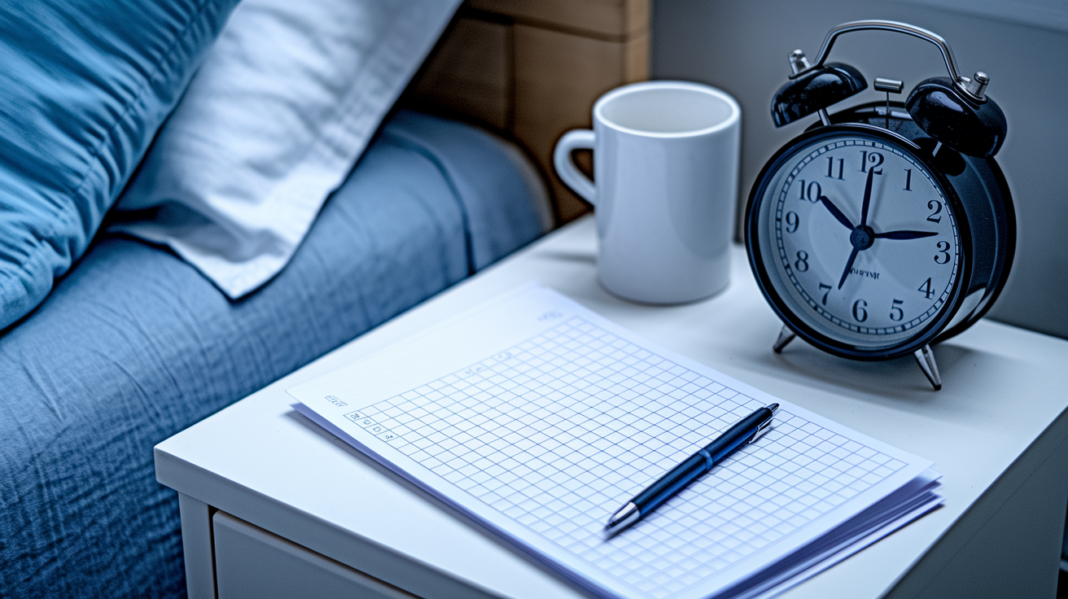

You probably think you need a sleep tracker to spot messy bedtimes. You don’t.
A simple 14-night paper routine, just a pen beside the bed and a short morning note, can show your real bedtime and wake time patterns.
It won’t tell sleep stages, but it will catch the timing that actually matters for feeling rested.
Over two weeks you’ll see whether your schedule drifts, which nights break the pattern, and one small, testable change to try next.
A 14-Night Paper Method For Measuring Sleep Patterns

Estimates work fine for tracking consistency. You don’t need to time every second. Manual records can’t capture sleep stages (that needs EEG), but a solid 14-night run will still show you real patterns in bedtime, wake time, and total sleep.
- Grab either a paper journal or a printable 14-day grid, and keep it with a pen right next to the bed.
- Before sleeping, jot down the date, bedtime, and lights-out time.
- After waking, estimate your sleep latency and any awakenings, then record wake time, naps, total sleep duration, and sleep quality on a scale of 1 to 5. Example entry: “Lights-out 23:15, fell asleep about 20 minutes later, woke once for 10 minutes, final wake 06:40, felt a 3 out of 5.”
- Do this every morning for at least 14 nights in a row. Enter your best estimate rather than leaving a field blank. Small, consistent entries beat sporadic perfection.
- Calculate estimated sleep onset as lights-out time plus sleep latency. Nighttime sleep duration is wake time minus estimated sleep onset minus estimated time awake overnight. Example: “Lights-out 23:30 plus latency 15 min equals onset 23:45. Wake at 06:45 means total sleep is about 7 hours.”
- Find your 14-night bedtime and wake-time ranges by subtracting the earliest time from the latest. Flag any range or individual night that drifts more than 60 minutes from your preferred schedule.
Here’s a ready-to-copy blank table for paper use. Reproduce fourteen rows, one per night, so you can run the full 14-night analysis without redrawing columns.
| Date | Bedtime | Lights Out | Sleep Latency (Min.) | Awakenings | Wake Time | Naps | Total Sleep Duration | Quality (1-5) |
|---|---|---|---|---|---|---|---|---|
Plot And Interpret A Weekly Sleep Consistency Chart

Want to see your consistency at a glance? Draw one weekly chart for nights 1 through 7, and a second for nights 8 through 14, once you finish a full run. Put days along the horizontal axis and clock times (say, 22:00 to 09:00) down the vertical axis. Plot bedtime and wake time as dots, or draw a horizontal bar from estimated sleep onset to wake time for each night.
- Mark nights within your intended schedule in green.
- Mark deviations greater than 60 minutes in red.
- Compare the earliest and latest bedtime to find your bedtime range.
- Compare the earliest and latest wake time to find your wake-time range.
Clusters of bars or dots sitting in a narrow band mean good consistency. Scattered points, wide ranges, or repeated red marks point to unstable stretches worth a second look. Those are the nights where you go back to your notes and test one small change.
Choose Your Paper Sleep Log

A free-form sleep journal and a printable grid both support the 14-night method. The real difference comes down to detail versus speed. Go with a journal if you want room to write context and feelings. Go with a grid if you want quick checkboxes and easy side-by-side comparison.
| Format | Best For | Structure | Main Trade-Off |
|---|---|---|---|
| Free-form paper journal | People who want room to describe routines, disruptions, or how they felt | Flexible dated entries with space for notes | Slower to compare across nights |
| Printable grid | Quick daily completion and side-by
Final WordsStart tracking tonight with the 14-night paper method: jot bedtime, lights-out, sleep latency, awakenings, wake time, naps, total sleep, and a 1-5 quality score each morning. Estimates are enough. Plot weekly charts to spot clusters or red flags, and pick the format you’ll actually use: free-form journal or printable grid. Manual logs won’t measure sleep stages, but they reveal schedule patterns. Treat this as a two-week experiment—tracking sleep consistency without device can quickly show what’s working, and that’s a win you can build on. FAQQ: How to track your sleep without a wearable?A: Tracking sleep without a wearable means using a simple paper log: each morning for at least 14 nights note date, bedtime, lights-out, sleep latency, awakenings, wake time, naps, total sleep, and a 1–5 quality score. Q: What is the 3-3-3 rule for sleep?A: The 3-3-3 rule for sleep is an informal guideline that varies by context; some use it for infant sleep training or short schedule shifts, so check the source or ask a clinician for the specific meaning. Q: Is there a device that just tracks sleep?A: A device that just tracks sleep does exist: bedside or under-mattress sensors and contactless radar mats track time in bed, movement, breathing, and heart-rate estimates but don’t measure sleep stages without EEG. Q: What is the 30-60-90 rule for sleep?A: The 30-60-90 rule for sleep is a napping guideline: choose naps of about 30, 60, or 90 minutes to match lighter sleep or a full 90-minute cycle, which can help reduce post-nap grogginess.  Subscribe for exclusive contentOn Sleep Health Wellness and More, Copyright - All Rights Reserved - 2026 |