



Can a handful of walnuts really help you fall asleep faster?
A small trial found that 40 grams of shelled walnuts, about a small handful, improved sleep quality and shortened the time it took young adults to drift off.
That’s an intriguing clue, not a cure.
So the short thesis.
Walnuts may give many people a modest, testable boost to falling asleep when used as a bedtime add-on, not a fix for chronic problems.
Try about 40 grams 30 to 60 minutes before bed and watch what changes.
The Short Answer: A Modest Potential Sleep Benefit

Walnuts might give your sleep a small boost and help you drift off a little faster, but the human evidence backing this up is still pretty thin. One randomised crossover trial followed 76 young adults who ate 40 grams of shelled walnuts every day, and it found improvements in sleep quality plus shorter sleep latency (the time it takes to actually fall asleep). That’s worth paying attention to. But it’s one study, one specific age group. Not proof this works for everyone, every night.
So what does that mean for you tonight? Try eating about 40 grams of shelled walnuts, roughly a small handful, somewhere between 30 and 60 minutes before bed. Think of it as an experiment on yourself, not a cure for chronic insomnia or a stand-in for the habits that actually move the needle, like a consistent bedtime and a dark, cool room. Walnuts for sleep can be a nice add-on to a routine you’ve already got going.
Why Walnuts Affect Sleep: The Science Behind It

The human trial measured real outcomes, better sleep quality and shorter time to fall asleep. But why walnuts might cause this is still more theory than settled fact. Researchers point to a handful of nutrients in walnuts that could plausibly support sleep, though nobody’s proven that any single one of them caused what people noticed in that study. Here’s what’s on the table.
Walnuts contain measurable amounts of melatonin, the hormone your body naturally produces to regulate sleep and wake cycles. Getting a bit of melatonin from food may add to what your body’s already making at night. That said, the amount in a handful of walnuts isn’t standardized like a supplement pill, so the effect probably varies from person to person.
Walnuts also contain tryptophan, an amino acid your body can convert into serotonin and then into melatonin. It’s a real biological pathway, no question there. But eating tryptophan doesn’t guarantee your body converts enough of it into melatonin to make a noticeable difference that night.
Magnesium shows up in walnuts too, and it plays a normal role in nervous system regulation and muscle relaxation. Low magnesium has been linked to restlessness in some research. Still, the magnesium in one serving of walnuts isn’t a sedative, and it won’t single-handedly resolve insomnia on its own.
ALA, or alpha-linolenic acid, is the plant-based omega-3 fat walnuts are especially known for. Some researchers suspect ALA may influence sleep-related signalling or even melatonin receptor sensitivity, meaning your body might respond to melatonin more effectively. This is still an early idea that needs more direct human research before anyone can say much with confidence. With all these possible pathways in mind, it helps to see how walnuts stack up against other foods people reach for at bedtime.
How Many Walnuts to Eat for Sleep and Best Timing
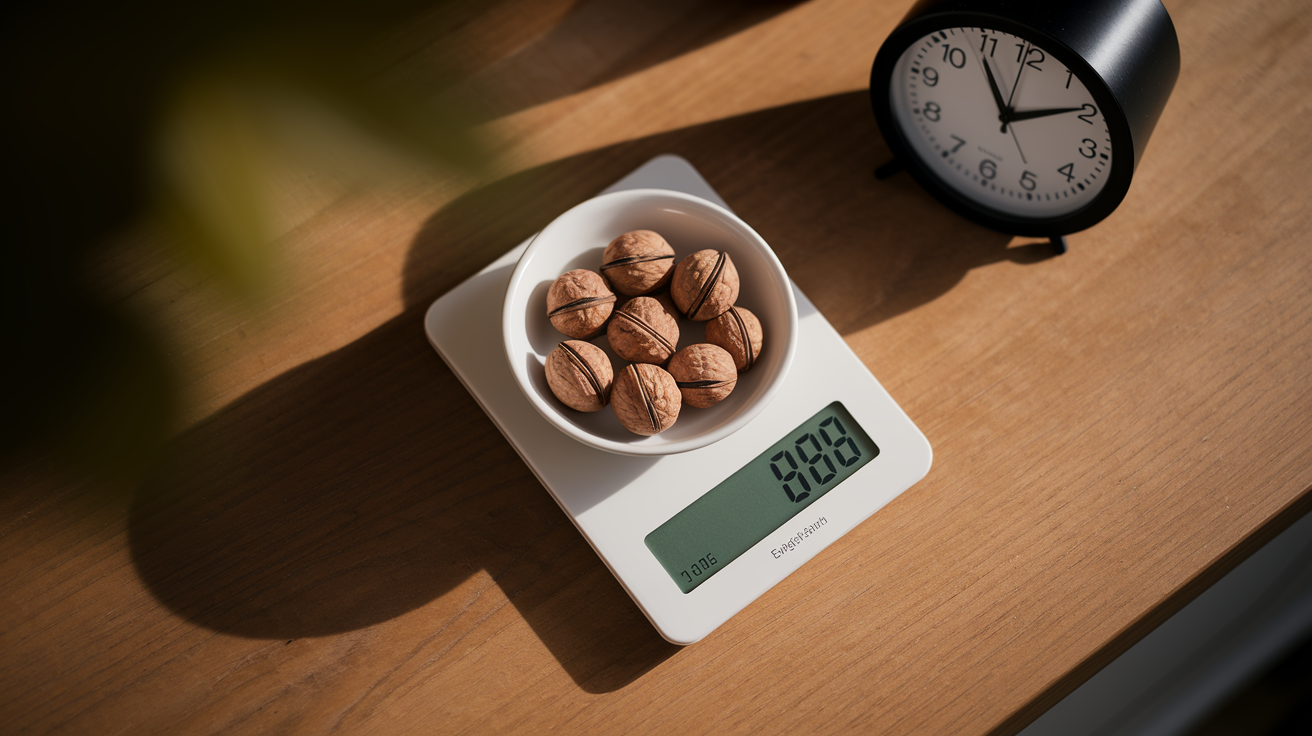
The reported trial used 40 grams of shelled walnuts daily, which comes out to roughly 260 calories and very little sugar. That’s about 15 to 20 walnut halves, though “about” is the key word, since walnut halves vary in size. If you want to match the study’s approach closely, weighing your portion on a kitchen scale beats eyeballing a handful.
Timing matters too. Most guidance points to eating your walnut serving 30 to 60 minutes before bed, giving your body time to digest and process the nutrients. If you deal with reflux or a sensitive stomach at night, you might do better pushing that window closer to 90 minutes. Eating a handful of nuts right as you’re lying down can leave you feeling uncomfortably full or dealing with digestive noise right when you’re trying to relax. Worth noting, this trial’s full publication details, journal, and exact date haven’t been independently confirmed here, so treat 40 grams as the amount used in one study, not an official medical recommendation.
| Guidance | Detail |
|---|---|
| Reported study serving | 40 grams of shelled walnuts daily |
| Approximate portion | About 15 to 20 walnut halves, roughly 260 calories, little sugar |
| Suggested timing | 30 to 60 minutes before bed; up to 90 minutes if prone to digestive discomfort |
| When to avoid eating | Right before lying down, since it may cause bloating or discomfort |
Walnuts Compared to Other Sleep-Promoting Foods

No single food wins the title of best bedtime snack, and walnuts are no exception. When you’re comparing options, it helps to look past just “does it contain melatonin” and consider sugar content, calories, serving format, and how strong the actual human research is behind each claim.
Walnuts bring ALA, fibre, protein, and very little sugar to the table. Almonds, on the other hand, are known more for magnesium and protein than for ALA. Both are reasonable nut choices, but the nutrient differences suggest they might work through somewhat different pathways rather than one being clearly better for sleep.
Pistachios are another whole nut snack worth mentioning, recognized as a dietary source of melatonin. That’s interesting, but having melatonin in a food doesn’t automatically mean it’ll outperform walnuts for sleep quality or latency. The research comparing these nuts head to head just isn’t there yet.
Tart cherries take a different approach. They contain melatonin along with compounds called procyanidins, including procyanidin B-2, which may help protect tryptophan from breaking down by inhibiting an enzyme called IDO. Howatson’s 2012 trial found that tart cherry juice concentrate increased melatonin levels and extended
Final Words
We ran the evidence and practical tips: a small randomized crossover trial with 76 young adults used a 40-gram serving of shelled walnuts and found modest improvements in sleep quality and shorter time to fall asleep. The article also explained possible nutrient pathways and compared walnuts with almonds, pistachios, tart cherries, and other tryptophan-rich foods.
If you want to test it, try about 40 grams of walnuts 30–60 minutes before bed as part of solid sleep habits and track how you feel. Walnuts for sleep can be a simple, low-risk experiment—worth trying and easy to reassess.
FAQ
Q: How many walnuts should I eat to help sleep?
A: The number of walnuts to eat to help sleep is about 40 grams (roughly 15–20 halves), the portion used in one trial; try it 30–60 minutes before bed and weigh portions for accuracy.
Q: Which is the best nut for sleep and what foods help you sleep all night?
A: The best nut for sleep and foods that help you sleep all night depend on nutrients and evidence; walnuts, almonds, pistachios, plus dairy, eggs, and seeds can help, but sleep habits matter more than any single food.
Q: What not to mix with walnuts?
A: What not to mix with walnuts is alcohol, very large or high-fat bedtime meals, or high-sugar snacks that can cause reflux or discomfort; and avoid walnuts if you have a tree-nut allergy and seek care for reactions.