



What if your constant tiredness, fog, and mood swings aren’t just life stress but a misaligned body clock?
When several symptoms show up together at the same times of day—late sleep, predictable energy crashes, foggy thinking, odd hunger or digestive trouble—that timing is the real clue.
This post lays out the common warning signs of circadian rhythm misalignment, how to spot the timing pattern that matters, and small tests you can try this week to see if your clock is the culprit.
What Are the Main Signs Your Body Clock Is Out of Sync?
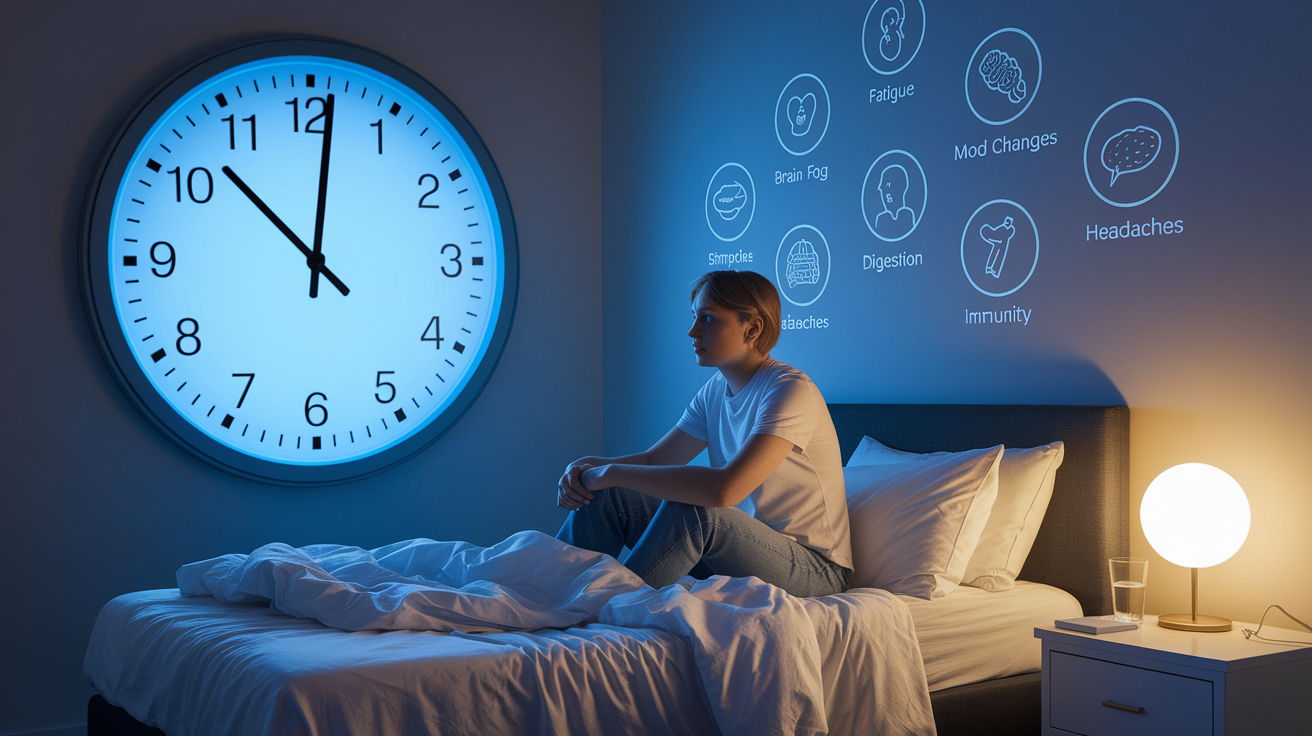
No single symptom proves your circadian rhythm is misaligned. Headaches happen. Bad moods happen. Everyone gets tired sometimes. But when several of these show up together, keep showing up at the same time of day, and started after a schedule change, a shift rotation, or travel, a timing problem becomes a lot more likely, especially if things improve once you’re allowed to sleep on your own schedule. Signs of a circadian rhythm disorder often cluster around sleep, alertness, cognition, and mood, which is exactly where this checklist starts.
Sleep and Wake Time Symptoms
- Sleep onset that’s substantially later than required, or unusually strong sleep pressure early in the evening
- Fragmented or shortened sleep, including a final waking time that happens earlier than intended
- Trouble waking at the required time, or sleep that stays unrefreshing despite adequate opportunity
Daytime Energy and Alertness Symptoms
- Excessive daytime sleepiness that may include unintended or accidental dozing
- Persistent fatigue, low stamina, or reduced capacity for routine activities
- Predictable energy or alertness crashes that hit at particular clock times
Cognitive and Performance Symptoms
- Brain fog or trouble sustaining concentration
- Memory lapses or reduced ability to make sound decisions
- Slower reactions, avoidable errors, or reduced workplace, school, and physical performance
Mood and Mental Health Symptoms
- Irritability or mood swings that follow disrupted or mistimed sleep
- Anxiety, unease, or heightened emotional sensitivity
- Low mood or reduced resilience to everyday stress
Digestive and Metabolic Symptoms
- Appetite changes or cravings that show up at unusual hours
- Bloating, heartburn, constipation, diarrhoea, or other time linked digestive discomfort
- Trouble regulating glucose or pronounced changes in hunger and energy after meals
Other Physical Symptoms
- Headaches, muscle tension, or altered temperature comfort
- Slower recovery from exercise, work, illness, or disrupted sleep
- More frequent infections or a sense of reduced immune resilience
This list means the most when it shows up as a pattern, not a one off. If you notice items from three or four of these categories happening on the same days, tied to the same triggers, that’s worth paying attention to. On their own, though, these symptoms are non specific. They can point to circadian misalignment, or to something else entirely.
How Can You Tell Whether the Pattern Reflects a Circadian Timing Problem?

The real clue isn’t the symptom itself. It’s the relationship between your sleep window and clock time. Ask yourself: does your preferred sleep time stay consistently late, consistently early, drift a little further each day, or swing wildly depending on whether you’re working or off? And here’s a useful test, does sleep actually get easier and more regular when you’re left alone to follow your own schedule, even if that schedule doesn’t match your obligations? That contrast, functioning fine on your own time but struggling on the required time, is often the strongest sign of a true timing issue.
Some patterns are stable, just shifted. Others creep later day by day instead of settling anywhere. And some only show up as a gap between weekday and weekend sleep, rather than one continuously shifted rhythm. The table below breaks down the four most common phenotypes.
| Circadian Phenotype | Typical Timing Pattern | How the Pattern Behaves | Distinguishing Clue |
|---|---|---|---|
| Delayed sleep phase | Sleep onset commonly after 2:00 a.m. | Stays consistently late night after night | Sleep is normal and refreshing if allowed to start after 2:00 a.m. and wake late morning |
| Advanced sleep phase | Sleepy in early evening, waking well before dawn | Stays consistently early, entire window shifted forward | No trouble falling asleep, but can’t stay asleep or stay up late |
| Irregular or non-24-hour timing | No fixed shifted time, drifts later each day | Progressive daily drift rather than one stable pattern | Sleep onset creeps later day over day instead of settling |
| Social jet lag | Large gap between workday and free day sleep | Two different rhythms depending on the day of the week | Sleep midpoint differs by more than 1.5 hours; weekend drift beyond 90 minutes |
If your complaints don’t line up with a consistent relationship to clock time, to work demands, or to a preferred sleep window, it might be worth looking elsewhere for the cause. Circadian misalignment has a signature. Random, inconsistent symptoms without that timing thread often point somewhere else.
What Causes Circadian Rhythm Disruption and Its Symptoms?

Circadian misalignment happens when your internal clocks, the central one and the peripheral ones scattered through your organs, fall out of sync with the world around you or with each other. What is circadian misalignment? breaks this down into central versus environment mismatches and internal clock versus clock mismatches, which is a useful way to think about why symptoms show up where they do.
Final Words
In the action, you saw a clear checklist of sleep, daytime, cognitive, mood, digestive, and physical signs and learned how to spot timing patterns.
Keep a 14-day record to compare workday and free-day sleep midpoints, note progressive drift, and try one simple timing change at a time—morning light, meal timing, or a consistent wake time.
Track circadian rhythm misalignment symptoms, review the pattern, and if problems persist for 2–4 weeks or create safety risks, bring your notes to a clinician.
You’ll likely notice better sleep, energy, and resilience with small, steady adjustments.
FAQ
Q: How can I fix a misaligned circadian rhythm?
A: You can fix a misaligned circadian rhythm by stabilizing wake time, getting morning daylight, dimming evenings, keeping regular meals and activity, avoiding late caffeine/alcohol, limiting naps, and testing timed light or melatonin with a clinician while tracking changes.
Q: How long does it take to realign your circadian rhythm?
A: Realigning your circadian rhythm typically shifts about one hour per day; jet lag often needs roughly one day per time zone, while digestive and metabolic systems may lag and recovery varies by age, chronotype, and light exposure.
Q: How to tell if your circadian rhythm is messed up?
A: You can tell your circadian rhythm is messed up when sleep timing repeatedly mismatches required hours, causing fragmented sleep, poor daytime alertness, mood or digestion changes—especially if symptoms follow travel, night shifts, and improve on your preferred schedule.
Q: What organ regulates circadian rhythm?
A: The organ that regulates circadian rhythm is the suprachiasmatic nucleus, a small brain region in the hypothalamus that acts as the master clock using light cues; other organs carry peripheral clocks tied to meals and activity.