

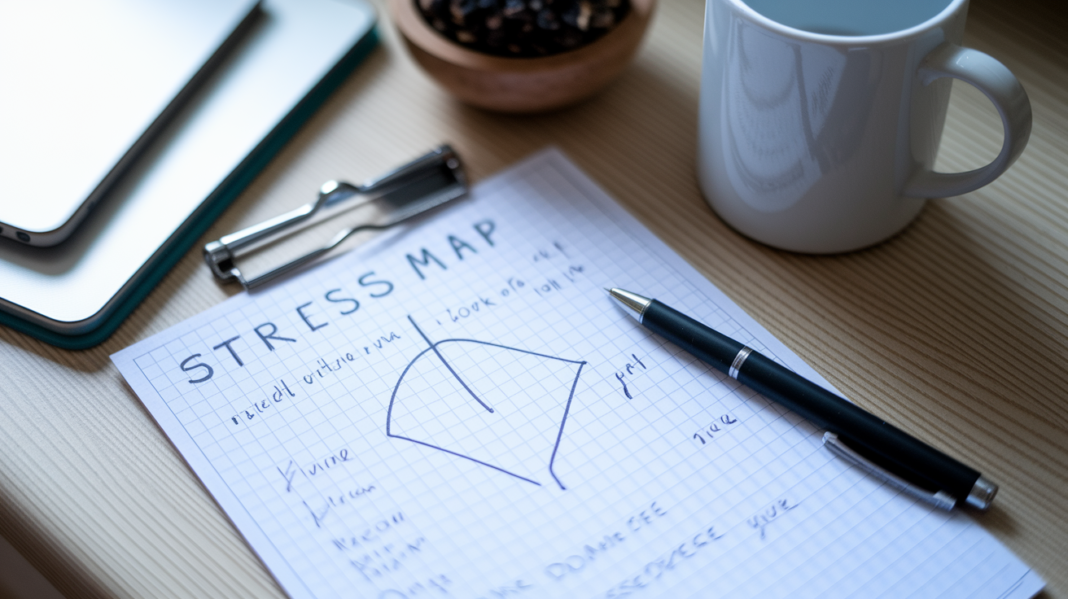

What if the fastest path to calm is a tiny, messy log you keep for a minute?
A stress map is exactly that: a short note written in order that links what happened to what you felt, how bad it was, how long it lasted, what you tried, and when you felt closer to normal again.
Spend 1 to 3 minutes after an episode, and you’ll start to spot repeat patterns.
This post shows eight simple steps to build a stress record you’ll actually use and small tests to try next.
No special gear needed.
Build Your First Stress Record in Eight Steps
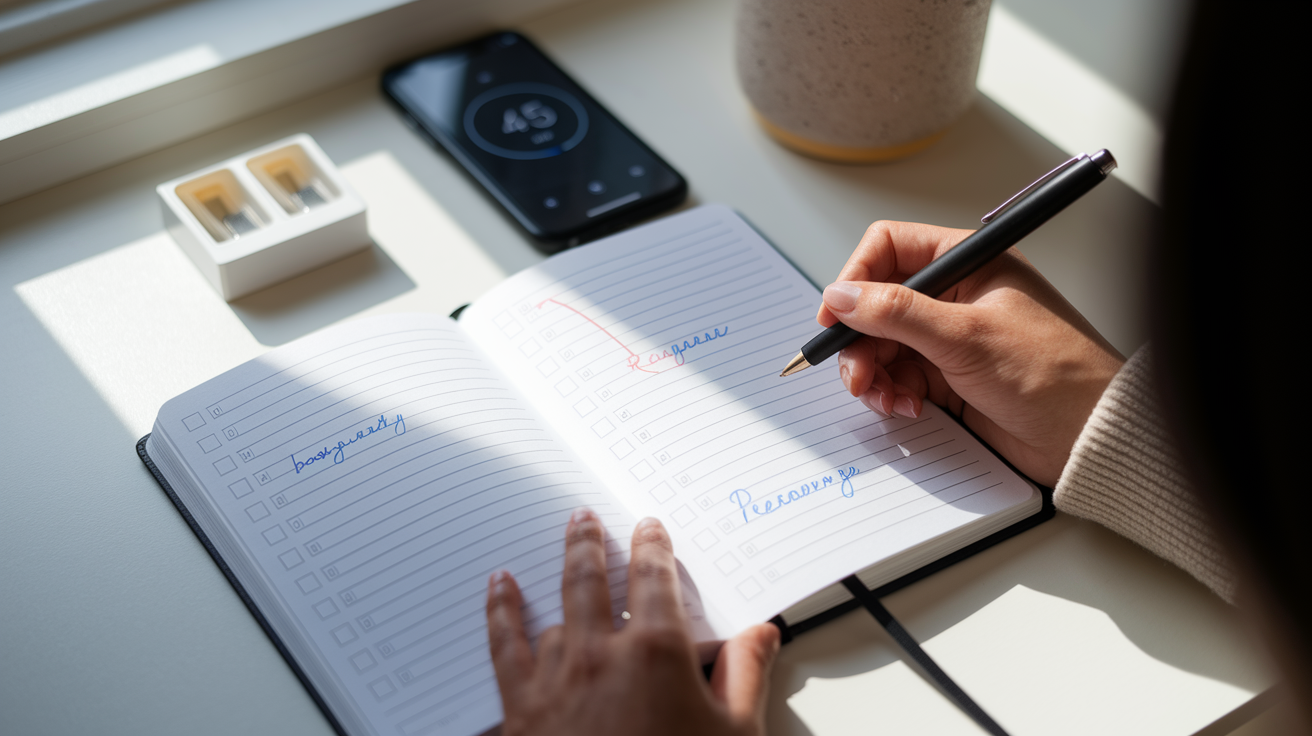
A stress map is a simple chronological record that connects a stressful event to what you felt, how bad it was, how long it lasted, what was happening around you, how you responded, and how long it took to feel okay again. You don’t need special equipment here. Paper, a notes app, or a basic spreadsheet all work fine.
The goal is something repeatable, a process you’ll actually stick with. Think 1 to 3 minutes per entry. Track it, spot the patterns, try something small, then check back in. Here’s how to start.
- Choose one tracking format: paper, spreadsheet, or app.
- Decide what counts as a noticeable stress episode for you.
- Make the entry as soon as it’s safe, aiming for 1 to 3 minutes.
- Note what happened right before the episode.
- Capture the main signs you noticed and give it a 1 to 10 intensity rating.
- Estimate how long the episode lasted.
- Note what you did and when you felt closer to your usual baseline.
- Keep capturing episodes consistently and use the scheduled reviews explained later in the article.
Here’s a compact line you can copy and reuse for every entry:
Date/time: ___ | What happened: ___ | Signs: ___ | Intensity: ___/10 | Duration: ___ | Response: ___ | Recovery: ___.
A quick, slightly messy note written in the moment is usually more useful than a detailed one you try to reconstruct hours later from memory. Memory tends to smooth things over, or exaggerate them. The point isn’t a perfect entry, it’s an honest one, caught close to when it actually happened.
Here’s what that compact line might look like filled in. Date/time: Tuesday, 3:40pm | What happened: last-minute work request | Signs: tight shoulders | Intensity: 7/10 | Duration: 20 minutes | Response: short walk | Recovery: back to about a 2 within half an hour. That’s it. That’s a complete, useful entry. The next section gives you the full diary template, with field definitions, intensity anchors, and a more detailed worked example to build from.
A Stress Diary Template for Recording Each Episode

Standardised fields matter because they let you compare one episode to another weeks apart. Without them, every entry is its own little island, and patterns stay hidden. With them, you start to see shape in the noise.
This section owns the full, detailed entry format. If you only have a minute, use the quick-start line from the previous section. Got a bit more time, or reviewing entries at the end of the day? This is the version to use.
| Field | What to Record | Example | Format or Scale |
|---|---|---|---|
| Date and start time | When the episode began | 2026-08-04, 14:10 | YYYY-MM-DD, HH:MM |
| Trigger or preceding event | What happened right before | Unexpected work request | Short phrase |
| Context and location | Where you were and what else was going on | Home office, working alone | Short phrase |
| Physical symptoms | Body sensations noticed | Tight shoulders, rapid heartbeat | List of signs |
| Thoughts and emotions | What you were thinking or feeling | Worried thoughts, frustration | Short phrase |
| Behaviour | What you actually did | Repeatedly checked messages | Short phrase |
| Intensity | How strong the episode felt | 7 | 1 to 10 scale |
| Duration | How long it lasted | 35 minutes | Minutes |
| Coping response | What you tried | Took a five-minute walk | Short phrase |
| Recovery time | How long until closer to baseline | Back to 3/10 after 20 minutes | Minutes, with intensity |
| Follow-up outcome | Any lingering effects later | Mild fatigue that evening | Short phrase |
Here’s how all 11 fields come together in one real entry. On 2026-08-04 at 14:10, an unexpected work request arrived while working at home alone. It brought tight shoulders and a rapid heartbeat, along with worried thoughts and frustration. The response was repeatedly checking messages. Intensity hit 7 out of 10, lasting about 35 minutes. A five-minute walk helped, bringing things down to a 3 out of 10 after 20 minutes, though mild fatigue showed up later that evening. This entry is just an example. It’s not meant to diagnose anything, just to show what a complete record looks like.
For the intensity scale, keep your anchors consistent across every entry. A 1 to 3 means noticeable but manageable, something you can work through without much trouble. A 4 to 6 is disruptive, pulling your focus or mood off track. A 7 to 8 is strongly impairing, hard to push through or ignore. A 9
Final Words
in the action, we walked through an 8-step quick stress record and a full diary template so you can start without special gear.
You learned how to tag triggers, note symptoms and recovery clues, pick a tool you’ll actually use, build charts, and test one small change at a time.
Try 1-3 minute entries for a week and then review. That simple habit will show you how to map stress episodes. Small tests and steady tracking make real, useful changes possible.
FAQ
Q: How to get out of chronic stress?
A: Getting out of chronic stress often starts by tracking patterns, reducing day-to-day triggers, building small habits—better sleep, regular movement, simple boundaries—and testing one change at a time; seek professional help if not improving.
Q: What are signs your body is shutting down from stress?
A: Signs your body is shutting down from stress include overwhelming fatigue, constant low energy, poor concentration, frequent illness, changes in appetite or sleep, dizziness, and slowed recovery—seek medical or mental-health support if severe or sudden.
Q: What are the 7 types of stress?
A: The seven types of stress are acute (short-term), episodic acute (frequent short bursts), chronic (long-lasting), eustress (positive stress), physical, psychological/emotional, and environmental stressors that affect daily life.
Q: How to prepare for a stressful event?
A: Preparing for a stressful event means spotting likely triggers, planning one or two coping moves (breathing, short walk, boundary), practising them, prioritising sleep and hydration, and scheduling a short recovery check-in afterward.