



Chasing eight hours in bed can actually make your sleep worse.
Sleep efficiency measures what percent of your time in bed you actually spend asleep instead of tossing, turning, or scrolling.
It’s one simple calculation you can do with a sleep diary or a tracker.
In this post I’ll show the formula, explain the pieces (time in bed, total sleep time, sleep latency, and WASO (minutes awake after you first fall asleep)), and give small, testable steps to improve your score so you wake less wired and more like yourself.
Sleep Efficiency Calculation Basics
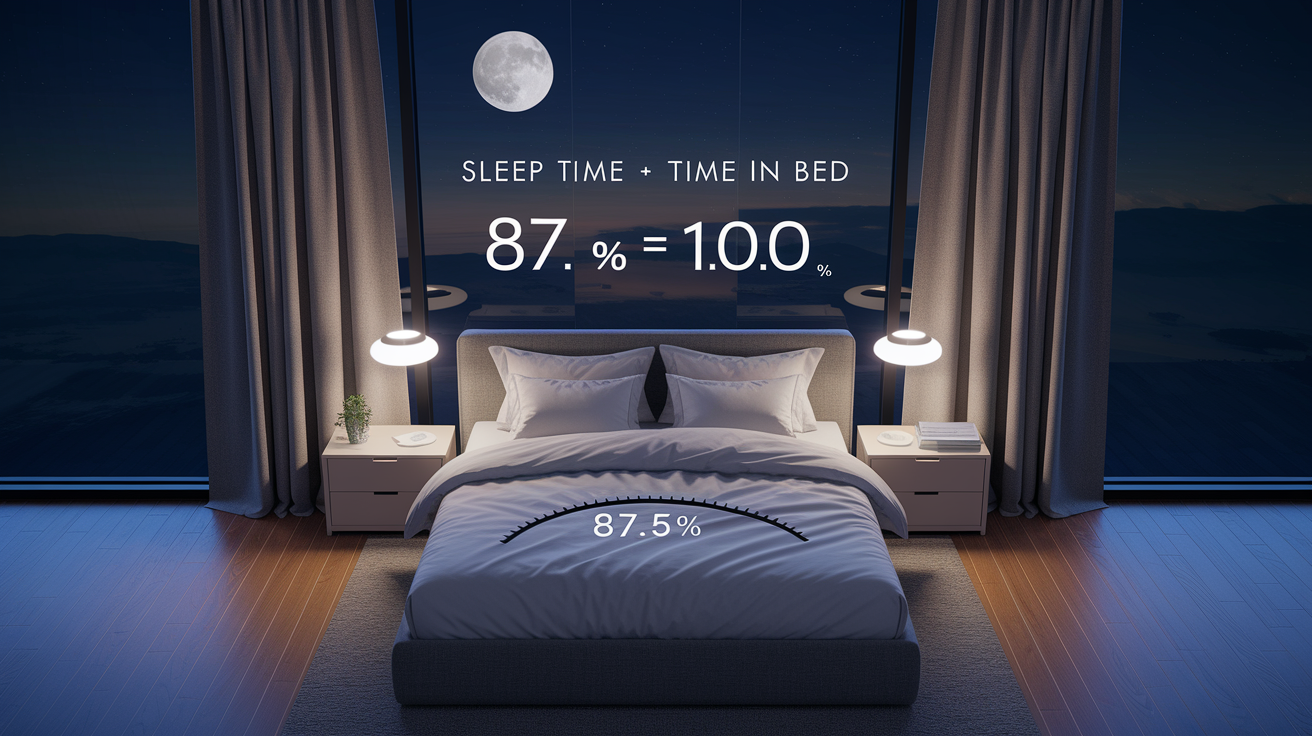
Sleep efficiency calculation is just math. It tells you what percentage of your time in bed you actually spent asleep, instead of tossing, turning, or scrolling your phone. The formula: Sleep Efficiency = (Total Sleep Time ÷ Time in Bed) × 100.
Here’s the formula in action with real numbers. Say you slept 420 minutes but spent 480 minutes in bed. That’s 420 ÷ 480 × 100, which equals 87.5%. One calculation tells you more about your night than how tired you feel in the morning ever could.
Once you’ve got your percentage, it helps to know what it actually means. Calculating sleep percentage is only useful if you understand the benchmarks behind it. Generally, 85% or higher is considered good. Land between 90 and 95%, and that’s optimal for most adults. Anything above 95% might sound impressive, but it can actually be a clue you’re not giving yourself enough time in bed to begin with. And if your number dips below 75 to 80%, that’s often a sign something is disrupting your sleep. Worth a closer look.
Define Time in Bed, Total Sleep Time, Sleep Latency, and WASO
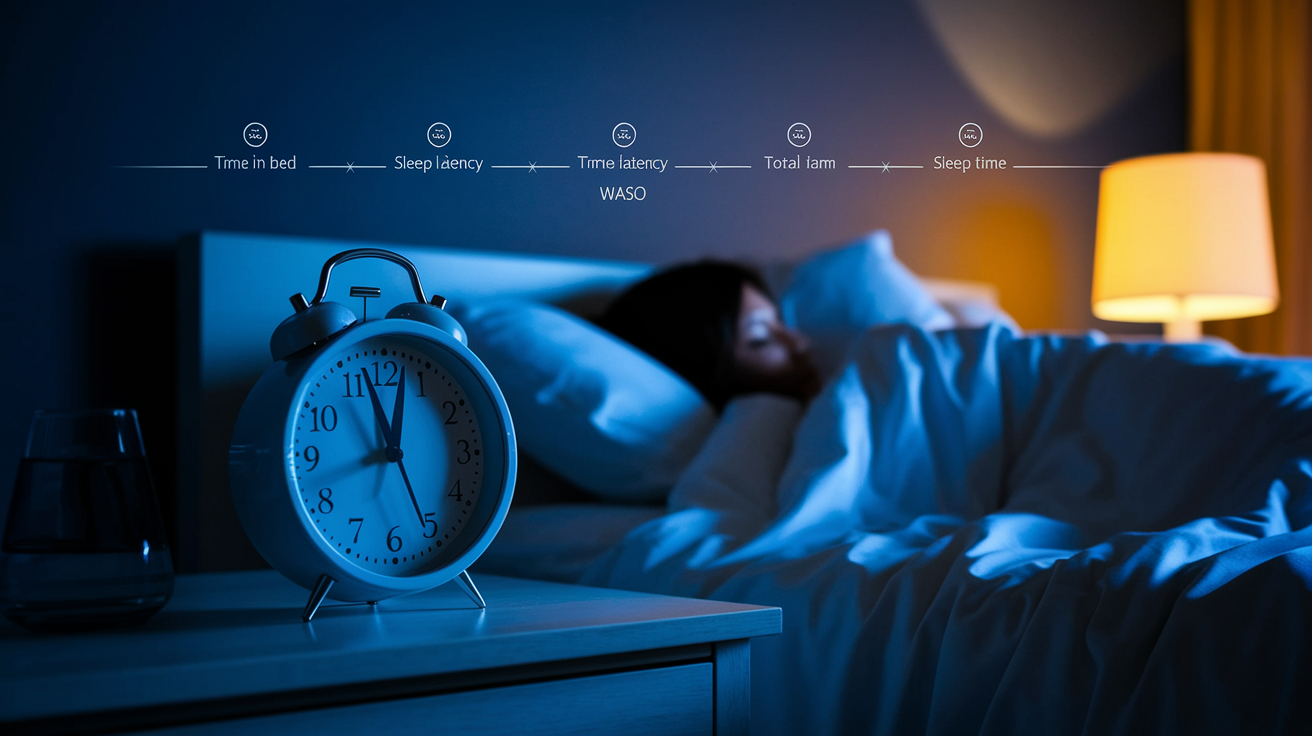
Before you can trust your sleep efficiency number, it helps to know exactly what’s being measured. Time in bed starts the moment you turn off the lights or settle in to sleep, and it ends at your final wake up time. This includes any minutes you spent lying there awake, staring at the ceiling, or checking the clock.
Total sleep time is a bit different. It’s your time in bed minus two things: how long it took you to fall asleep, and how much time you spent awake during the night after you’d already drifted off. Think of total sleep time as the “real” sleep hiding inside your time in bed.
Those two gaps have names. Sleep latency, put simply, is the time between lying down and actually falling asleep. Ideally this takes somewhere between 10 and 20 minutes. If it regularly stretches past 30 minutes, that’s often a sign your body isn’t winding down the way it should. Wake after sleep onset, or WASO, covers the minutes you’re awake after initially falling asleep, like a 3 a.m. wake up that turns into 45 minutes of staring at the wall. Ideally, WASO stays under 30 minutes. The higher it climbs, the more it drags your efficiency number down.
A handful of everyday habits tend to widen the gap between time in bed and actual sleep:
- Naps taken too late in the day or for too long
- Caffeine or alcohol too close to bedtime
- Irregular sleep and wake schedules
- Ongoing stress or a racing mind at night
- Certain medications, including some sleep aids
- Hormonal shifts, like those during perimenopause or menopause
Sleep Efficiency Calculation: Step-by-Step Method

Once you understand the pieces, the sleep efficiency calculation itself is just basic division. The trick is being consistent with your units. Minutes are usually easier than juggling hours and fractions of hours.
Here’s the process, broken into four steps:
- Record your scheduled bedtime and rise time to find your total time in bed.
- Add up the actual minutes you spent asleep, leaving out any awake time, to get your total sleep time.
- Convert both numbers into the same unit. Minutes work best for accuracy.
- Divide total sleep time by time in bed, then multiply by 100 to get your percentage.
Let’s look at how this plays out with a few different scenarios.
| Scenario | Time in Bed | Total Sleep Time | Sleep Efficiency |
|---|---|---|---|
| Example A | 8.0 hours (480 min) | 6.5 hours (390 min) | 81.25% |
| Example B | 7.0 hours (420 min) | 6.0 hours (360 min) | 85.71% |
| Example C | 9.0 hours (540 min) | 6.0 hours (360 min) | 66.67% |
| Diary example | 10:15pm–9:00am (645 min) | 370 min (after 80 min awakenings) | 57% |
That last row deserves a quick walkthrough since it mirrors how sleep diary methods actually work. If you fell asleep at 12:30am and woke for good at 8:00am, that’s a 450 minute sleep window. Subtract 80 minutes of nighttime awakenings, and you’re left with 370 minutes of actual sleep. Compare that to a time in bed of 645 minutes (10:15pm to 9:00am), and you get a sleep efficiency of just 57%. A clear sign that something in that night’s routine needs attention.
If you’re tracking over a week, don’t average your nightly percentages together. Instead, add up all seven nights’ total sleep time, add up all seven nights’ time in bed, then divide those two totals. This gives you a more accurate weekly trend than averaging separate percentages, which can skew your results if one night was unusually good or bad.
Measuring the Inputs: Sleep Diaries, Wearables, and Polysomnography
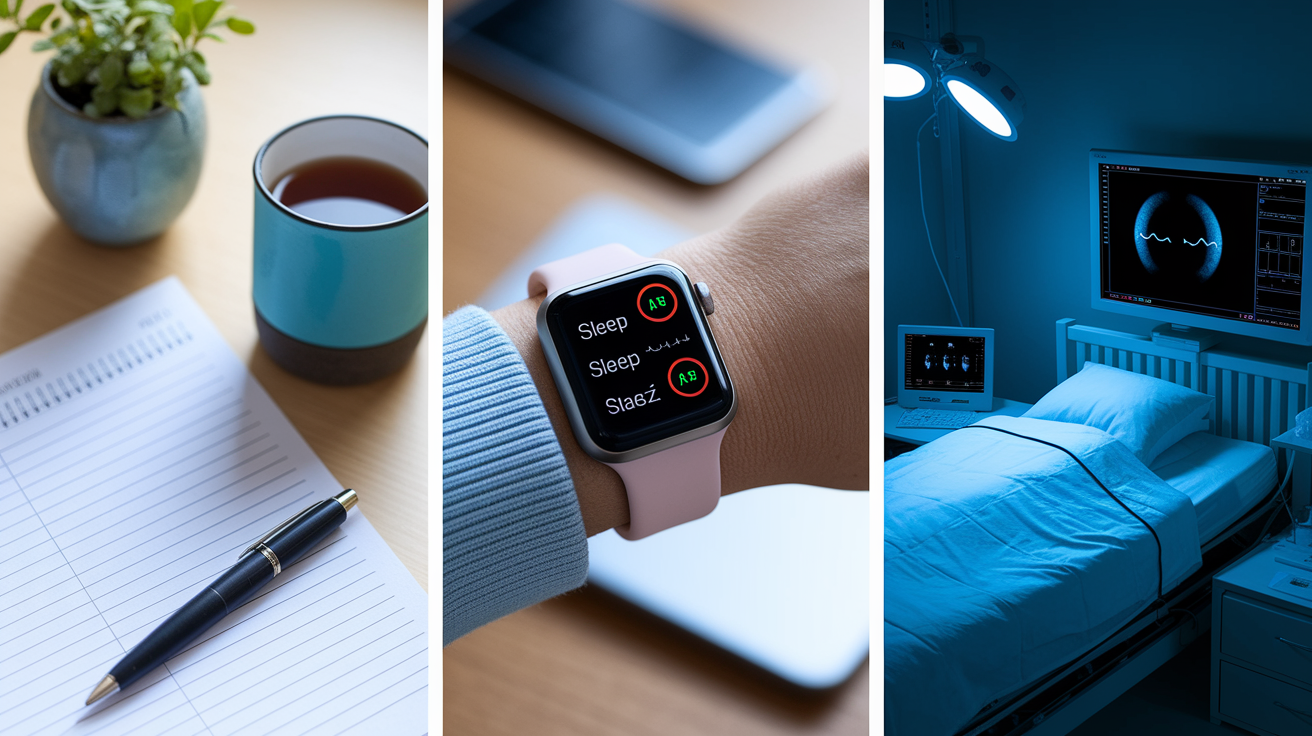
Getting an accurate sleep efficiency calculation depends entirely on how well you’re measuring time in bed and total sleep time in the first place. There are three main ways people do this, and each comes with its own tradeoffs.
Sleep diary methods are the simplest and most accessible option. You jot down when you went to bed, roughly when you fell asleep, any awakenings during the night, and your final wake time. The accuracy here depends on how consistent you are with recording minutes and hours.
Final Words
In the action, you got a clear definition of sleep efficiency and the formula: Total Sleep Time divided by Time in Bed, times 100, plus a quick example and benchmarks to know what’s good.
You learned what Time in Bed, Total Sleep Time, sleep latency, and WASO mean, and what commonly cuts into sleep.
Then we walked through a 4-step calculation, unit conversion, weekly averaging, and how diaries, wearables, or polysomnography measure inputs.
Try the sleep efficiency calculation as a one-week experiment. Track, tweak one small habit, and compare numbers. You’ll likely spot a useful pattern.
FAQ
Q: Is 89% sleep efficiency good? What’s a good sleep efficiency number? Is an 80% sleep efficiency considered normal?
A: An 89% sleep efficiency is good. Generally 85% or higher is considered good, 90–95% is optimal, above 95% may mean too little time in bed, and under 75–80% is poor.
Q: What is the 10 3 2 1 0 sleep rule?
A: The 10-3-2-1-0 sleep rule is a simple pre-bed checklist: 10 hours – avoid heavy meals; 3 hours – no alcohol; 2 hours – stop work; 1 hour – no screens; 0 – no caffeine.