

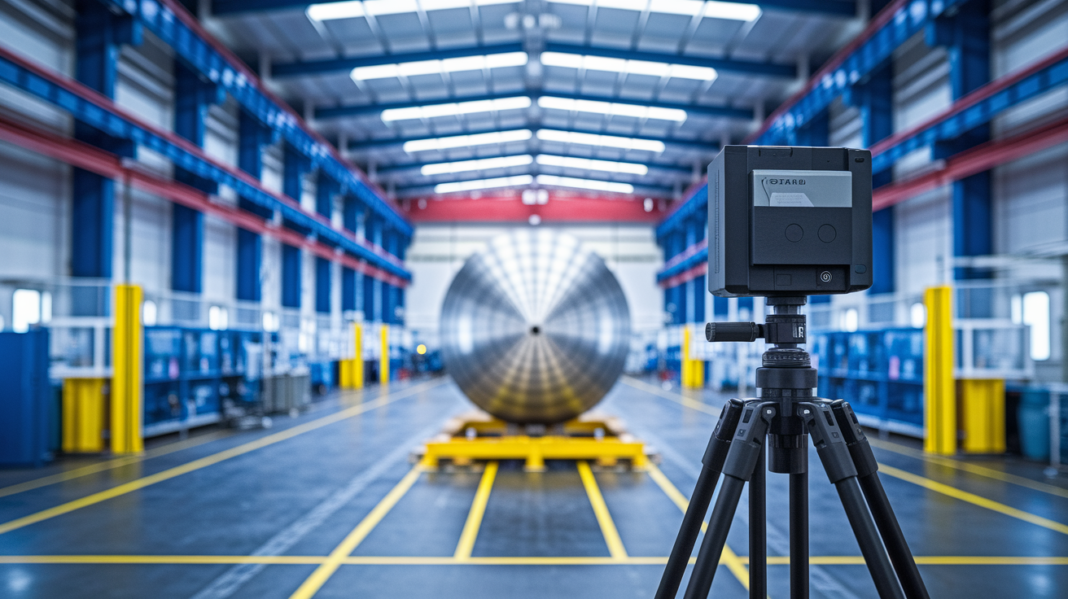

Think a laser tracker is just a fancy ruler? Think again.
It shoots a tight laser beam at a small reflective target and reads two angles and a distance to locate that target in 3D space.
By turning azimuth, elevation, and range into X, Y, Z coordinates dozens to thousands of times per second, it can follow moving parts with micron-level accuracy.
This article breaks down the beams, retroreflectors, encoders, and distance methods so you can see exactly how laser tracking measures motion.
What Laser Tracking Means And How It Delivers 3D Position Data
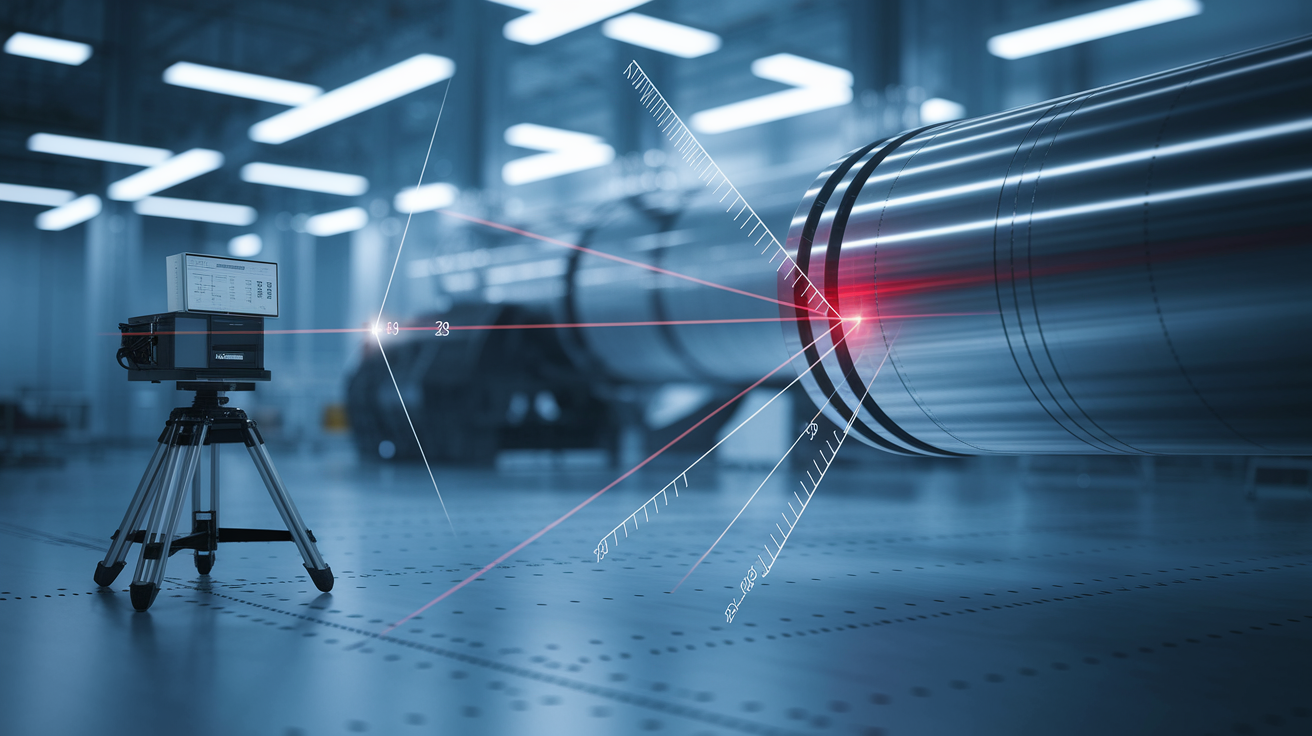
Laser tracking is a measurement method that uses a beam of laser light aimed at a small reflective target to figure out exactly where that target sits in 3D space. It works out this position by measuring two angles and one distance, then turning those three numbers into X, Y, and Z coordinates. That’s really the core answer to how laser tracking works: angles plus distance equals location, calculated dozens of times per second.
The tracker itself acts as the starting point, or origin, of its own coordinate system. Think of it like the center of a map where X, Y, and Z all equal zero. From there, it sends out a laser point, waits for it to bounce back off the target, and reads the return signal to calculate exactly how far away and at what angle that target sits.
Coordinate metrology basics come down to this triangulation style approach. The tracker can sweep a full 360 degrees horizontally and about 138 degrees vertically, covering nearly the entire space around it. Most units measure out to roughly 80 meters, holding accuracy within a handful of microns. That’s a level of precision that rivals dedicated coordinate measuring machines, or CMMs.
This technology first showed up in the late 1980s and early 1990s, built for industries that needed large object precision without the limits of a fixed measuring arm. Since then, it’s become a staple in manufacturing, aerospace, and construction, anywhere someone needs to check that a physical object matches its digital design.
From here, the rest of this article breaks down the mechanics behind that measurement, piece by piece.
The Core Mechanism Behind Laser Tracking

Laser tracking relies on a tight loop of light, sensors, and motors working together in real time. Here’s the step by step version of what actually happens each time the tracker takes a reading.
- Laser emits a beam toward the target
- Beam travels through air to the retroreflector
- Retroreflector returns beam directly back to tracker
- Sensor measures time of return or phase to calculate distance
- Angular encoders record azimuth and elevation angles
- Software fuses distance and angle data into X, Y, Z coordinates
That distance calculation comes from timing. The laser emits a point, and the system reads how long it takes for that point’s reflection to return. Faster returns mean the target is closer, slower returns mean it’s farther away. This time of flight measurement happens fast, since the tracker can emit around 1,000 points every second.
While that’s happening, the vertical encoder (often labeled EL, for elevation) and the horizontal encoder (AZ, for azimuth) are recording exactly where the tracker head is pointed. These encoders are precise enough to catch tiny shifts in angle, and that data gets paired with the distance reading to calculate a full 3D position.
Here’s the tricky part: the target usually isn’t sitting still. Operators move it by hand across a part or surface being measured. To keep the beam locked on, small motors inside the tracker head constantly adjust its aim based on feedback from the encoders. This closed loop control system recalculates and repositions roughly every 0.001 seconds, or about 1,000 times per second. That’s fast enough to follow a moving target without losing the connection.
Many trackers use a Class II Helium Neon laser as the light source for this process, chosen for its stability and safety at close range. The combination of steady beam output, fast point emission, and rapid encoder feedback is what lets the system deliver real time position data instead of a single static snapshot.
Distance Measurement Methods Used In Laser Tracking Systems
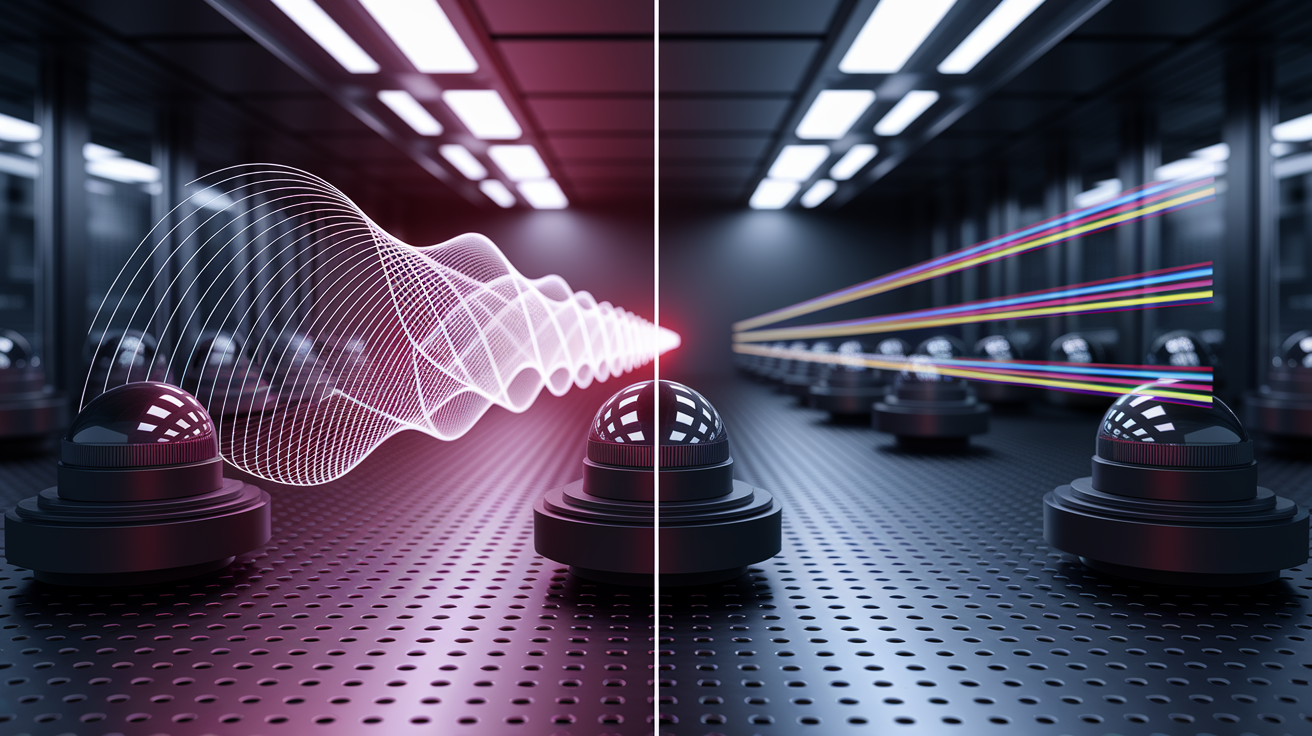
Distance is one of the two core numbers a laser tracker needs, and there are two different ways it can get that number. Each comes with its own strengths, and most trackers lean on one or combine both depending on the task.
Interferometry: Measuring Relative Distance
Interferometry works by tracking tiny changes in the laser beam’s wave pattern as the target moves. It’s extremely precise for following motion, catching movement changes down to a fraction of a wavelength. But there’s a catch. Interferometers only measure relative distance, meaning they need a known starting point to work from.
If the beam gets blocked, even briefly, the system loses its reference point and can’t tell you the absolute position anymore. It has to be reset from a known location before it can pick back up. This makes interferometry great for continuous, uninterrupted tracking, but limited when line of sight breaks happen often.
Absolute Distance Meters (ADM): Phase Shift Ranging
Absolute Distance Meters solve that reset problem. An ADM sends out signals at multiple wavelengths and measures the phase shift, meaning the difference between the wave sent and the wave that returns. It starts with a longer wavelength to get a rough sense of range, then switches to shorter wavelengths to narrow that measurement down to a precise, absolute distance.
Some newer systems, sometimes described as sixth generation ADM, integrate the angle and distance measurement onto the same beam path. This reduces drift that can happen when a separate interferometer beam and angle reading beam aren’t perfectly aligned.
The trade-off comes down to speed versus certainty. ADM gives you an absolute position every time, even after an interruption, but it tends to work a bit slower than interferometry. Interferometry is faster and extremely precise for tracking motion, but it’s relative only and vulnerable to any break in the beam.
Retroreflectors And Target Technology In Laser Tracking

None of this measurement works without something for the laser to bounce off of. That’s where the retroreflector comes in, and it’s a simpler piece of hardware than the tracker itself, but just as important to getting an accurate reading.
Most laser trackers use a spherically mounted retroreflector, often shortened to SMR. It’s built around a corner cube prism, which has a neat trick built into its design: it sends the laser beam straight back to where it came from, no matter what angle the beam hits it at. That means an operator can move the SMR around a part’s surface without constantly worrying about angling it perfectly toward the tracker.
This reliable bounce back is what keeps the distance and angle readings accurate as the target moves. Signal strength does matter here.
Final Words
You now know a laser tracker finds a part in 3D by sending a laser to a retroreflective target and measuring angles plus distance to compute X, Y, Z in real time.
The device times the beam return, reads azimuth and elevation, and uses interferometry or phase-shift ADMs for distance. Motors steer the head to keep the beam locked, and SMRs bounce the light back no matter the angle.
If you’re still asking how does laser tracking work, remember: angle + distance + feedback = micron-level 3D position. Try it on a practice job and you’ll spot the pattern.
FAQ
Q: How accurate is a laser tracker?
A: The accuracy of a laser tracker is typically within a handful of microns, offering CMM-level precision across ranges up to about 80 meters with 360° horizontal and 138° vertical coverage.
Q: How does a laser tracker work?
A: A laser tracker works by sending a laser to a retroreflective target, measuring azimuth and elevation angles plus distance, then fusing those values into X, Y, Z coordinates with the tracker as the coordinate origin.
Q: How does laser tag know who shot who?
A: Laser tag systems know who shot whom by encoding each shot with a player ID (usually infrared or radio); the target vest’s sensor reads and logs that ID to register the hit.
Q: What is the difference between a laser scanner and a laser tracker?
A: The difference between a laser scanner and a laser tracker is scanners sweep to create dense surface point clouds, while trackers precisely measure a single retroreflective target’s 3D position for metrology.