



Not every post-workout ache is a badge of honor—sometimes it’s a warning light.
So how do you tell the difference between normal muscle soreness and something that needs real attention?
Look at three simple signals: when the pain started, how it feels, and whether it limits your movement.
If it’s delayed, dull, and gets better with light activity, you’re probably fine to keep moving.
But if it’s sudden, sharp, pinpointed, or stops you from using the muscle, that’s a signal to stop and check in.
Read on to learn simple steps to test what’s going on and what to try.
Is It Normal Post-Workout Discomfort Or A Warning Sign?

Here’s the quick version. If your discomfort showed up a day or two after your workout, feels achy and spread across a whole muscle group, and it’s already getting better, that’s most likely regular soreness. If your pain started suddenly, feels sharp or pinpointed to one spot, and it’s getting worse or stopping you from moving normally, that’s a signal worth paying attention to. No single sign proves anything on its own, but together they help you figure out whether to rest easy or get checked out.
| Signal | Likely Soreness (DOMS) | Likely Injury |
|---|---|---|
| Onset timing | Delayed, shows up 24 to 72 hours after exercise | Immediate or worsens over hours to days |
| Pain quality | Dull, achy, tight | Sharp, stabbing, or burning |
| Location | Diffuse, spread across the muscle | Localised, often a single tender point |
| Bilateral vs unilateral | Both sides sore after symmetric loading | One side only, no mirrored discomfort |
| Response to movement | Improves with light activity | Worsens with movement or specific motions |
| Function/range of motion | Near normal strength and mobility | Reduced strength, limited motion, or instability |
| Duration | Resolves within 3 to 7 days | Persists, plateaus, or worsens beyond a week |
| Severity/action | Monitor, keep moving gently | Stop activity, evaluate further |
- Continue light activity: Makes sense when discomfort is delayed, spread out, mild to moderate, gets better with gentle movement, and doesn’t mess with your normal function.
- Stop and rest: Needed for sudden or focal pain, symptoms that are getting worse, reduced strength or range of motion, instability, or pain that changes how you normally move.
- Seek urgent care: Necessary for deformity, not being able to bear weight, major swelling or bruising, a pop followed by loss of function, numbness or tingling, progressive weakness, severe worsening pain, dark urine, or a noticeably swollen muscle after intense exercise.
So here’s the actual decision you’re making. Delayed, diffuse, improving discomfort can usually be watched with light activity and a little patience. Sudden, focal, function-limiting, or worsening symptoms need a medical check, not another day of telling yourself you’ll see how it feels tomorrow.
Pain Onset And Timing When Assessing Exercise Discomfort
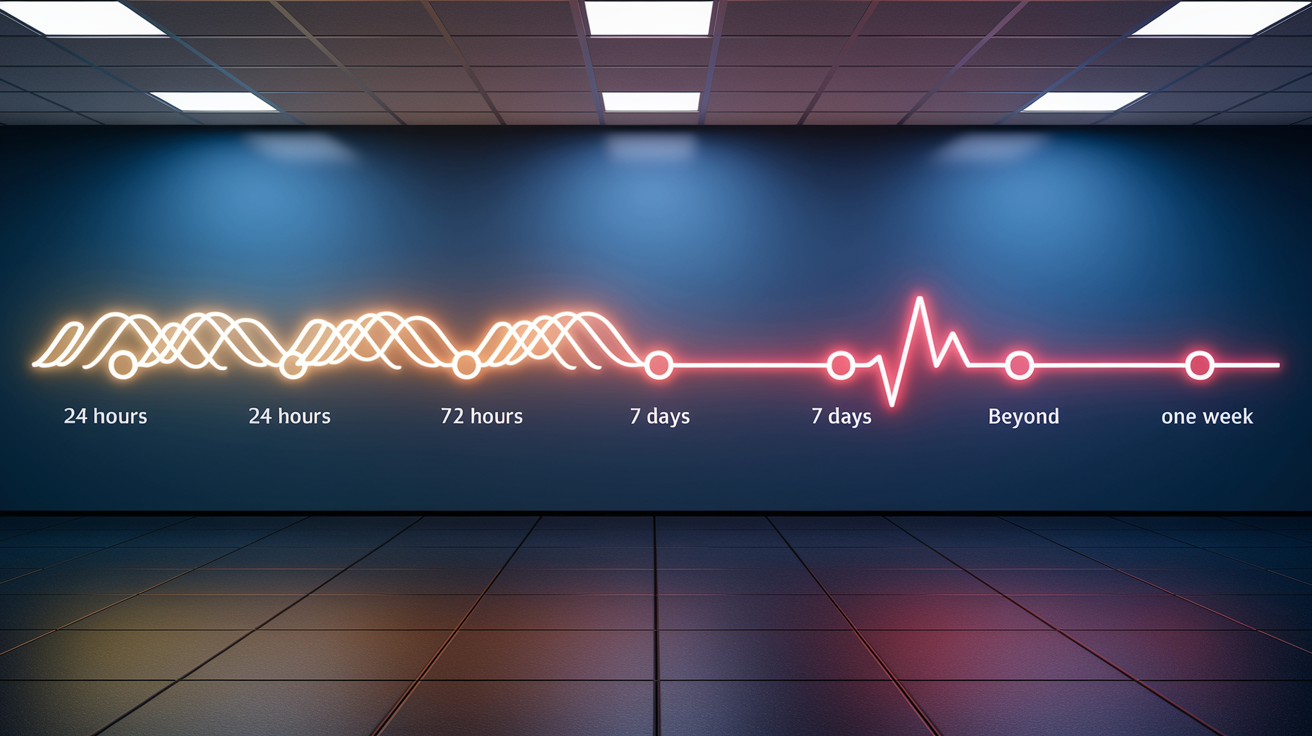
Timing tells you a lot. Maybe more than any other single clue. DOMS has a pretty predictable schedule. It shows up 24 to 72 hours after you push harder than usual, peaks somewhere in that same window, then fades over the following days. Most people feel noticeably better within 3 to 7 days, sometimes described as a tighter 3 to 5 day window. That delay is actually part of the pattern. It’s not the workout hurting you in the moment, it’s your muscle repairing itself afterward.
Injury pain doesn’t usually wait around. A strain often hurts right away or within a few hours of whatever caused it. A fracture or a tendon rupture tends to announce itself immediately, sometimes with an audible pop. And recovery timelines diverge fast from there. A mild strain might take 1 to 3 weeks. A moderate one, 3 to 8 weeks or more. A severe tear can mean months of recovery and possibly surgery. Fractures typically need 6 to 12 weeks just for the bone itself to heal. If your pain is still sitting there unchanged after 5 to 7 days, or hasn’t budged after a full week, that’s outside the usual soreness pattern.
- 24 to 72 hours: The usual onset and peak window for DOMS.
- 3 to 7 days: The period where routine soreness should substantially improve or resolve.
- One week: Symptoms should show a clear improving trend by this point.
- Beyond one week: Persistent, unchanged, or worsening pain calls for a look into whether it’s an injury or something else going on.
Timing gets you most of the way there, but it works best alongside what the pain actually feels like and where it’s showing up.
Pain Quality, Location, And Symmetry

DOMS tends to feel dull. Heavy. Tight, like your muscles got wrapped a little too snugly. It spreads across the whole muscle group you worked, not one exact spot. Do a leg day or a long run and it’s common to feel that same heavy ache on both sides, since the load was symmetric to begin with.
Injury pain reads differently. It’s more often sharp, stabbing, or has a burning quality that dull soreness just doesn’t produce. And it tends to be localised, sometimes to a spot small enough to point at with one finger. That kind of pinpoint tenderness is worth noticing, since it can suggest a strain, tendon irritation, or something structural going on underneath. One-sided pain after a symmetric workout, like only your right hamstring screaming while your left one feels fine, is more of a flag than matching soreness on both sides.
Worth saying though, these patterns aren’t airtight. Referred pain (pain felt somewhere other than its actual source) and plain old individual variation can muddy the picture.
Final Words
If discomfort arrived 24–72 hours after a new or harder session, feels dull and spread out, and eases with gentle movement, it usually points to DOMS.
Pain that starts during exercise, is sharp or pinpoint, one-sided, limits movement or strength, or gets worse needs evaluation.
When comparing soreness versus injury symptoms, use timing, quality, symmetry, and function checks: try light activity for likely soreness, stop and rest for focal or worsening pain, and seek urgent care for red flags. Small tests and tracking often point you to the right step.
FAQ
Q: How to tell if it’s soreness or injury?
A: To tell soreness from injury, look for delayed 24 to 72 hour, diffuse, improving ache after exercise; that suggests DOMS and not a structural injury. Immediate, focal, worsening, or function-limiting pain suggests possible injury needing evaluation.
Q: Do I have rhabdo or just sore?
A: To tell rhabdo from routine soreness, watch for very severe muscle pain, marked swelling, weakness, lightheadedness, or dark brown urine after intense exercise; these signs need urgent medical care, while routine DOMS lacks systemic symptoms.
Q: Does soreness count as an injury?
A: Soreness usually does not count as a structural injury when it is delayed, diffuse, and improves with movement; persistent, worsening, or function-limiting soreness may reflect an injury and needs assessment.
Q: How would you distinguish pain from tenderness?
A: To distinguish pain from tenderness, know pain is felt at rest or with movement, while tenderness is pain provoked by pressing the area; sharp, focal tenderness often points to injury, broad achy tenderness leans toward DOMS.