

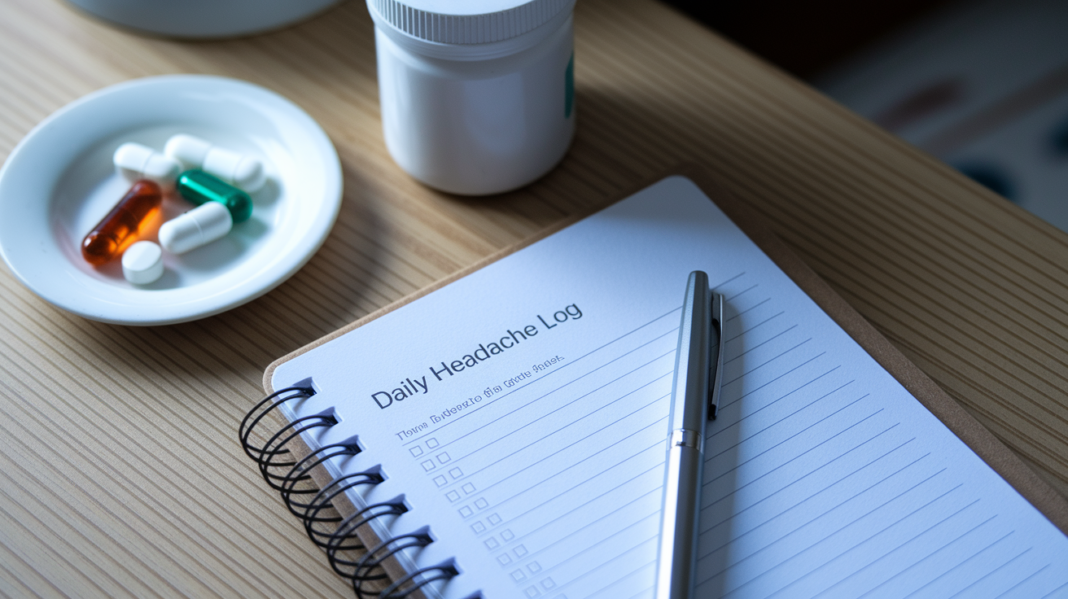

Most people track headaches wrong.
They wait until a bad attack and try to remember details later.
That’s how patterns get missed.
Try a five-part daily log instead.
Write a one-minute check-in every day, even on headache-free days.
Note start time, intensity, related symptoms, meds, and whether relief followed.
Do this for 30 days and hidden triggers often show up.
You’ll also get a simple test to try and clearer notes for your clinician.
The Five-Part Daily Headache Log

Systematic headache tracking comes down to writing something down every single day, whether or not you had head pain. It links your symptoms, the medication you took, whatever context seems relevant, and how things turned out. That’s it. Think of it as a daily habit rather than a project, and it works best when the entry is short enough that you’ll actually do it.
The five-part daily method:
- Complete one check-in every day, including headache-free days.
- Record each attack’s start time, duration, intensity, location, and pain quality.
- Note associated symptoms such as aura, nausea, dizziness, neck pain, and light or sound sensitivity.
- Log medication name, dose, timing, and relief.
- Review the record weekly and prepare a brief monthly summary.
Minimum viable daily entry:
- Date
- Headache: yes or no
- Start time
- Duration
- Intensity from 0 to 10
- Location
- Medication
- Relief
Start with 30 consecutive days. That’s usually enough to see whether obvious patterns exist. If your headaches are unpredictable, or your clinician wants a stronger baseline, extend to 90 days.
Add contextual fields like sleep, stress, food, or weather only once this basic template feels easy, not before. Piling on detail too early is one of the fastest ways to abandon a tracker. And to be clear, none of this replaces an evaluation from a qualified healthcare professional. It just gives you and them better information to work with.
Pros and Cons of Paper, Spreadsheet, App, and Hybrid Logs

There’s no single best format here. The right pick depends on how consistent you can realistically be, whether screens make your head pain worse, your comfort with spreadsheets or apps, how deep you want your analysis to go, and whether you’ll need to hand a report to a clinician.
| Tracking format | Main advantages | Main limitations | Privacy consideration | Best use case |
|---|---|---|---|---|
| Paper diary | Private, screen-free, no battery needed, always accessible | Hard to analyze, easy to lose, manual summaries take time | Stays fully local, but needs secure physical storage | People sensitive to screens during attacks |
| Spreadsheet | Custom formulas, charts, moving averages, flexible fields | Requires setup time and ongoing backups | Depends on where the file is stored and shared | Readers comfortable with basic formulas who want deeper analysis |
| Migraine tracking app | Reminders, calendar views, automated charts, CSV/PDF export | Subscription costs, variable privacy policies, feature limits | Health data may be stored or shared per app policy | People who want automation and easy clinician exports |
| Hybrid system | Flexible entry options across settings | Risk of duplicate or incomplete records | Split across two systems, so both need protection | People who log quickly in an app but write detailed notes on paper |
Practical advantages and limitations:
- Paper is screen-free and simple, but it can be lost and requires manual summaries.
- Spreadsheets allow custom calculations, but they need setup and regular backups.
- Apps provide reminders, charts, and exports, but they may collect sensitive health data or restrict features through subscriptions.
- Hybrid tracking allows flexible entry but creates duplication unless one record is designated as authoritative.
Whatever format you choose, a few privacy habits are worth building in. Use a device lock screen, actually read app permissions and data handling terms before you enter anything, and pick a backup method you trust. Confirm you can export or delete your data if you ever want to switch tools, and only share reports with the people you intend to, like your own clinician. Paper records need attention too. A notebook left on a desk or in a bag isn’t private just because it’s not digital.
Before committing to a 30 to 90 day baseline, try your chosen format for seven days first. Aim to keep the daily entry to about one or two minutes. Whatever you can still do reliably on a bad day, headache or not, is probably the format worth sticking with.
What a Paper Headache Diary Records
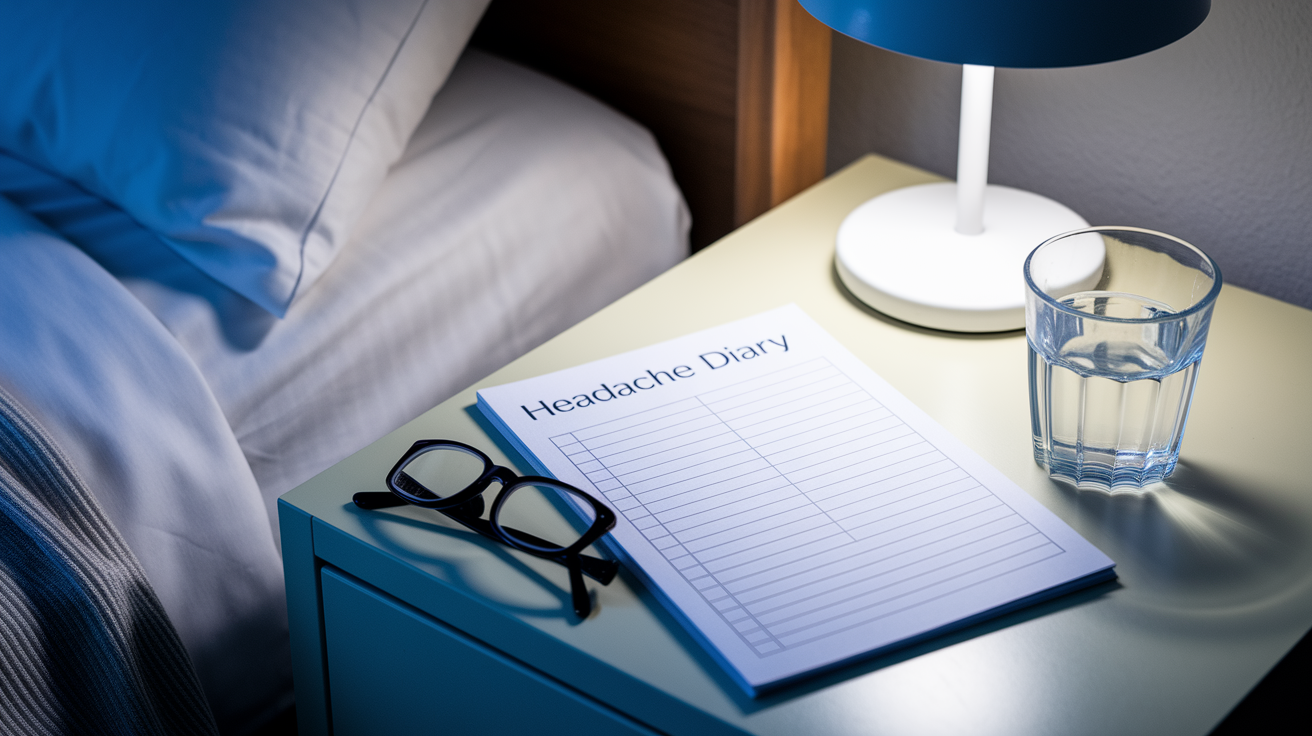
A printable paper diary works well when you want something screen-free sitting on a nightstand, tucked in a bag, kept in a desk drawer at work, or used by a caregiver who needs to document an episode you can’t log yourself. There’s no app to open, no battery to worry about, and no light-sensitive screen glare during an attack.
The layout matters more than it seems. Large checkboxes, clearly labeled scales, and high contrast all reduce how much writing you actually have to do while your head is pounding. A well-designed page lets you circle or check most fields and only write a sentence or two in a small notes box. For more detail on structuring this kind of layout, see Migraine Diary: What to Track and Free Template.
| Printable diary field | Paper layout | Example |
|---|---|---|
| Date/time | Boxed date field plus a simple time slot grid | Onset at 07:30 |
| Duration | Fill-in blank for hours/minutes | 120 minutes |
| Intensity |