



Training harder isn’t always the answer.
The real edge comes from tracking recovery markers every morning.
These are simple signals, like heart rate variability, sleep, soreness, hydration, and more, that tell you how well your body bounced back from stress.
When you watch them over time, you stop guessing and start training by readiness.
This post lays out eight markers to check daily, how to measure each one, and clear triggers for adjusting load so you can get faster, stronger, and avoid setbacks.
Recovery Markers Athletes Should Monitor Daily

Recovery markers are measurable signals, physical, chemical, and performance based, that show how well your body has bounced back from training stress. They work better than guesswork because they catch patterns your energy levels might hide. And recovery doesn’t happen on one timeline. Autonomic recovery (your nervous system settling down) happens within hours. Muscular repair and glycogen refilling take 24 to 72 hours. Endocrine adaptation, the hormonal side of adapting to training, stretches out over days or even weeks.
This matters because how you feel on a given morning is only part of the story. Subjective feeling alone isn’t enough to prevent reinjury or catch overtraining early. Athletes who train based on actual recovery readiness, rather than a fixed calendar schedule, tend to see 15 to 20 percent greater performance improvements over time. That’s a meaningful gap, and it comes down to tracking the right things consistently.
Before any of this data means much, you need an individualized baseline establishment protocol. Give yourself a minimum of 4 weeks in relatively low stress conditions to figure out what’s normal for your body. From there, longitudinal tracking and trend analysis over 7 to 30 day windows will tell you far more than any single morning reading ever could.
Here are the eight recovery markers athletes should track, with how to measure each one and when to adjust training.
| Marker | Why It Matters | How To Measure | Baseline/Range | Adjustment Trigger |
|---|---|---|---|---|
| Heart Rate Variability (HRV) | Reflects nervous system balance and readiness | Chest strap or wearable, lying down, upon waking | 50 to 140+ ms depending on fitness level | Drop below 80% of baseline for 3+ days |
| Resting Heart Rate (RHR) | Shows cardiac efficiency and systemic stress | Wearable or manual pulse check each morning | 40 to 55 bpm athletes, 60 to 75 bpm average adults | Sustained rise above baseline or over 80 bpm |
| Sleep Duration and Quality | Drives hormone release and tissue repair | Wearable sleep tracking, sleep diary | 7 to 9 hours, 15 to 20% deep sleep | Below range for 3+ nights |
| Muscle Soreness | Signals muscular repair status | Self rated soreness scale, 0 to 10 | Mild soreness resolving in 48 to 72 hours | Soreness persisting beyond 72 hours |
| Hydration Status | Affects blood volume, HRV, and performance | Urine color, body weight changes | Pale yellow urine, weight stable day to day | Weight loss over 2% body mass post session |
| Body Composition | Shows if training builds or breaks down muscle | Periodic body composition scan | Stable or improving lean mass over training cycle | Unexplained muscle loss over 4 to 6 weeks |
| Mood and Stress | Early signal of overreaching, often before physical markers shift | Daily wellness questionnaire | Stable or improving scores | Declining scores 3+ days running |
| Performance Benchmarks | Direct measure of whether recovery is translating to output | Jump tests, sprint times, lift numbers | Within 5% of personal best | Drop of 10%+ from baseline |
No single marker tells the whole story on its own. A high HRV reading means little if sleep has been falling apart for a week, and a good mood score doesn’t cancel out rising creatine kinase. Looking at these markers together, tracked over 7 to 30 day trends rather than single days, gives you the clearest picture of where you actually stand. The sections below dig deeper into each one.
Heart Rate Variability And Resting Heart Rate As Recovery Markers
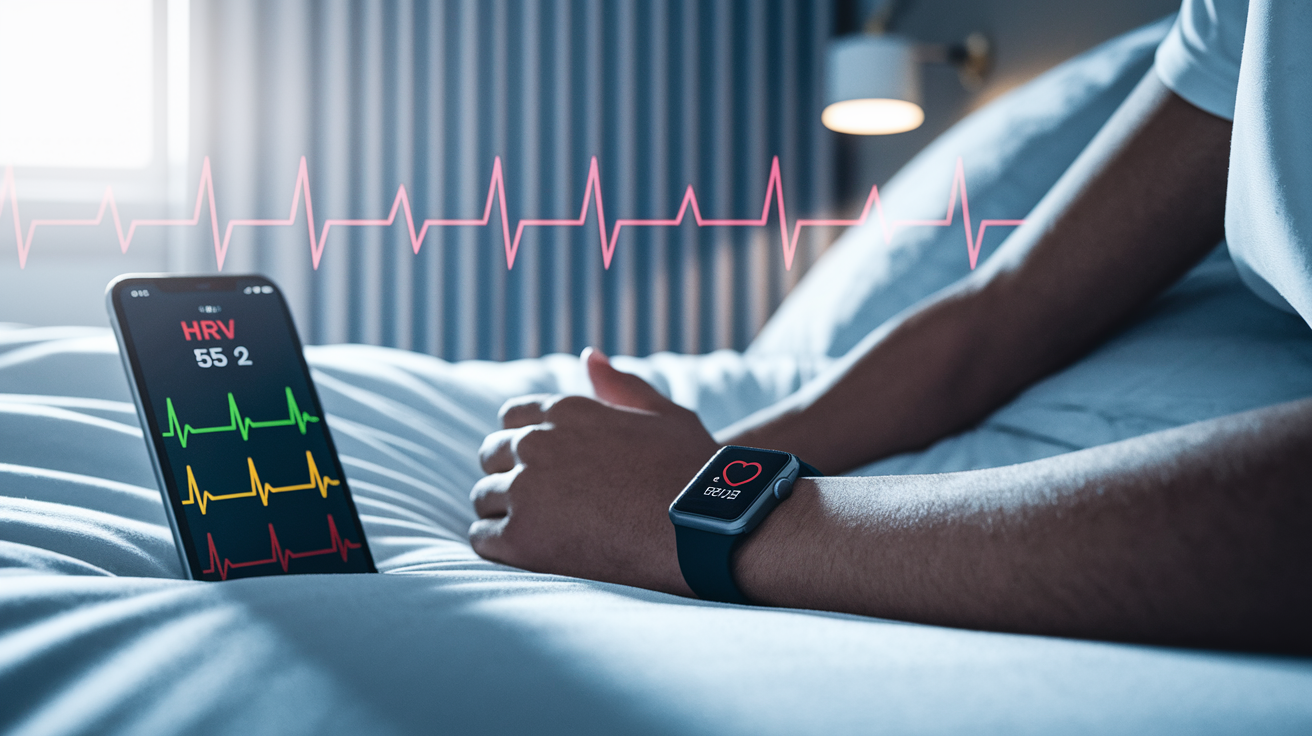
HRV and RHR are the two most accessible objective recovery markers, and together they form the backbone of most daily tracking systems. HRV, measured through RMSSD (the root mean square of successive differences between heartbeats), reflects how well your autonomic nervous system is balancing stress and recovery. RHR, simpler but still useful, shows how hard your heart is working just to keep you ticking over at rest.
Getting consistent readings depends on following the same protocol every time. Here’s what that looks like:
- Measure within 10 minutes of waking, before coffee, phone scrolling, or getting out of bed.
- Stay lying down, not sitting or standing, since position changes the reading.
- Record for 2 to 5 minutes to get a stable number, not a snapshot.
- Use a chest strap or a validated wearable device, and stick with the same one daily.
Give yourself 7 to 10 days of measurements before trusting any baseline number. From there, watch your HRV in zones. Green means you’re above 90% of your baseline, a solid signal that high intensity work is fine. Yellow, between 80 and 90% of base
Final Words
Track HRV, RHR, sleep quality, muscle soreness, hydration, body composition, mood, and performance benchmarks daily to catch signs you need more rest. These markers map to quick autonomic shifts, 24-72 hour muscle repair, and longer endocrine adaptation.
Set a 4-week baseline in lower-stress periods, then watch 7-30 day trends instead of single-day blips. Combine objective data with how you feel to guide training and recovery choices.
Use these recovery markers athletes should track as a short checklist: change one small thing for a week, log it, reassess, and you’ll train smarter and feel better.
FAQ
Q: How do athletes recover?
A: Athletes recover by tracking short- and long-term signals—autonomic (hours), muscular (24–72 hours), and endocrine (days–weeks)—using sleep, HRV, RHR, soreness, hydration, and performance trends to guide rest and load.
Q: What is the 4-2-1 rule for athletes?
A: The 4-2-1 rule for athletes is a simple timing guide for fueling: a full meal about 4 hours before activity, a light snack 2 hours before, and quick carbs 1 hour prior to train or compete.
Q: What are some signs that I need a rest day?
A: Signs you need a rest day include persistent high resting heart rate, low HRV, 3+ nights of poor sleep, increased muscle soreness, slower workouts, rising perceived exertion, or irritability and low motivation.
Q: What is the best recovery for runners?
A: The best recovery for runners combines sufficient sleep, targeted refueling, hydration, easy low-impact movement, monitoring HRV/RHR and soreness, and spacing intense sessions to allow 24–72 hours for muscle repair.