



Think 20/20 vision means eye tracking is fine? Think again.
Visual tracking is how the eyes follow a moving object, and you can screen it today with a pen, steady hands, and a few clear moves.
This quick guide shows step-by-step how to run a reliable visual tracking test, what patterns to watch for like jerky pursuit, head compensation, or trouble crossing the midline, and how to record what you see.
Follow these simple steps, treat results as clues not diagnoses, and know when to bring your notes to an eye care or developmental pro.
Quick-Start Guide To Running A Visual Tracking Test

Visual tracking is the eyes’ ability to follow a moving object smoothly, using eye movement alone, not the head. It’s built from a few smaller skills working together: fixation, saccades, smooth pursuit, and convergence. If you’re new to this and just need to get started today, here’s the essential version of how to run a quick screening.
Here’s what to do, step by step:
- Grab a simple target. A pen, a penlight, or a small toy all work fine.
- Hold the target about 14 to 16 inches from the person’s face. Close enough to see clearly, far enough to move freely.
- Move the target in a horizontal line, then vertical, then a slow circle. Keep the pace slow and steady, no sudden jumps.
- Do 2 to 3 passes in each direction before moving to the next pattern.
- Remind the person to keep their head still and only move their eyes. This part gets skipped a lot, and it changes the results.
- Watch closely and jot down what you see. Is the movement smooth, or jerky? Does the gaze cross the midline (the invisible line down the center of the face) without hesitation? Any overshooting or undershooting when the eyes jump to a new spot? Is the head sneaking in to help?
- Compare what you observed against what’s expected: smooth and symmetrical tracking in both eyes, in every direction.
That’s the whole gaze tracking overview in a nutshell. Simple setup, a few passes, careful eyes on the eyes.
One important note before you start. This quick version is a screening tool, not a diagnosis. It’s meant to flag a possible pattern worth looking into, not confirm what’s going on. If you notice jerky movement, head compensation, or trouble crossing midline, that’s a signal to loop in an eye care provider or developmental specialist for a full look.
For the deeper how-to on scoring and interpreting what you saw, skip ahead to the scoring and interpretation section later in this guide. And if you’re wondering which equipment fits your situation, whether that’s a plain pen or something more high-tech, the materials section below breaks that down.
Understanding The Core Eye Movements Behind Visual Tracking
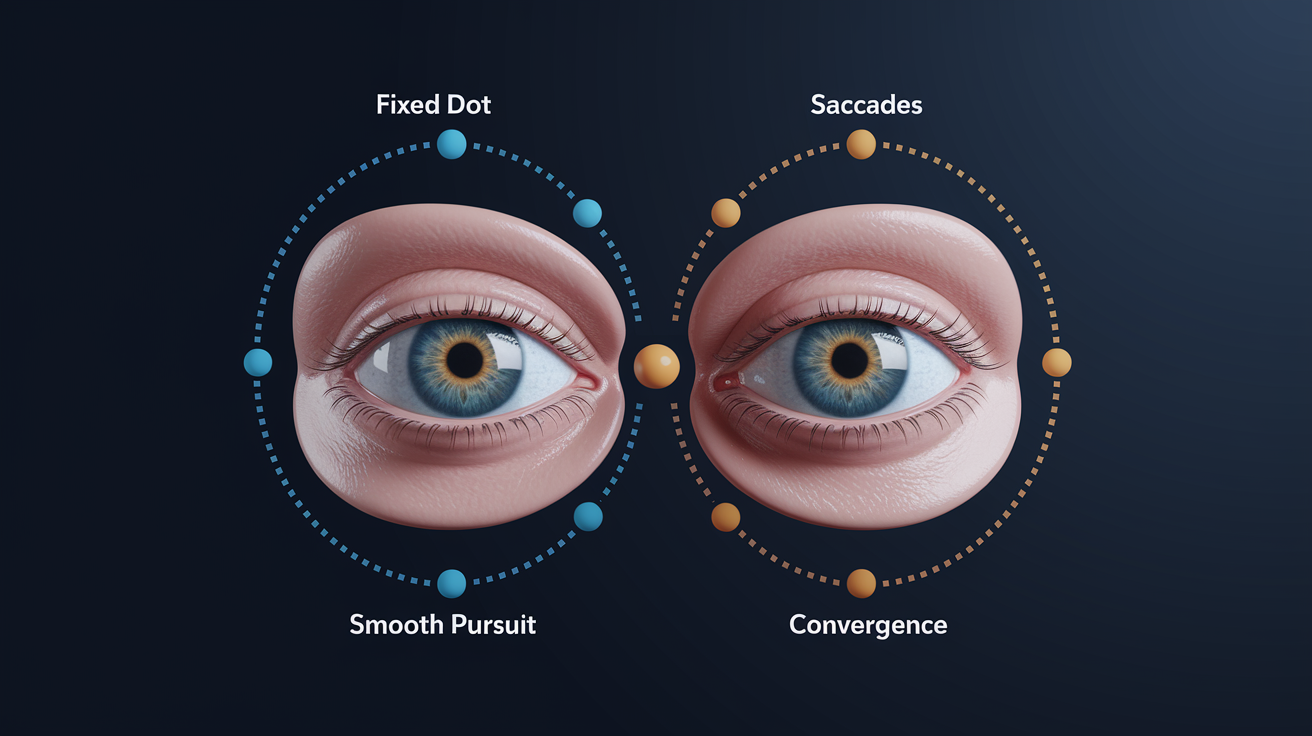
Before running any kind of test, it helps to know what you’re actually watching for. Visual tracking is made of a few distinct pieces, and each one shows up differently when something’s off.
Fixation is the ability to hold your gaze steady on one point, like looking at a friend’s face without your eyes drifting. Saccades are the quick, jump-like movements the eyes make when shifting from one point to another, say, from one word to the next while reading. Smooth pursuit is the ability to follow a moving target continuously, like tracking a car as it drives past. Convergence is what happens when both eyes turn inward together to focus on something close up, like a bug on your nose. Oculomotor control ties all of this movement together, while visual spatial attention is the mental part, the ability to notice and focus on where things are in space.
Here’s the tricky part. Visual tracking is not the same thing as eye teaming, also called binocular vision, which is about both eyes working together to form a single, unified image. These two systems can have problems on their own or together, and here’s the piece people often miss: normal visual acuity, meaning someone can see 20/20 on a chart, does not mean their tracking or teaming is working well. A person can see clearly and still struggle to follow a moving object smoothly.
Fixation typically develops by around 4 weeks of age, one of the earliest visual skills to come online. From there, tracking abilities continue to mature all the way through adolescence, before gradually declining later in life. Keeping this timeline in mind helps set realistic expectations when testing children versus adults.
Materials You Need Before Testing

What you’ll need depends heavily on whether you’re running a simple manual screening or a more detailed digital assessment. Both approaches are valid. It just depends on your setting and what level of detail you’re after.
For most basic screenings, keep it simple:
- A target to track. A pen, penlight, or small toy works well
- A stopwatch or timer, useful for timed reading-based tests
- A quiet room with steady, even lighting
- Comfortable seating that keeps the person stable
- A chin rest, optional, but helpful for reducing head movement during testing
- Digital or infrared tracking hardware, optional, for more objective, computer-based measurement
That covers the basics. If you’re deciding between a plain pen-and-paper approach, a tablet app, infrared goggles, or a full video-oculography setup, the next section walks through how those options compare and when each one makes sense.
Visual Tracking Test Variations You Can Administer

Not all visual tracking tests measure the same thing, which trips people up more than you’d expect. The bedside pursuit and saccade screening described earlier, using a pen or penlight, directly observes ocular motor control in real time. DEM and reading-based tests, on the other hand, measure reading speed, attention, and visual processing. Those depend on tracking ability, but they’re not interchangeable with a raw eye-movement assessment. Understanding which one you’re running, and what it actually tells you, matters for how you interpret the results.
The Developmental Eye Movement (DEM) test is a paper-based tool that times how quickly someone reads vertical columns and horizontal rows of numbers. It’s designed to assess reading speed and visual processing rate rather than pure eye-motor control. Digital versions of the DEM exist too, which can speed up scoring and reduce human error in timing.
The timed visual tracking test works similarly. It has the person read rows of single-digit numbers as fast as they can, and it’s used to get a read on speed, attention, and visual processing. This one’s flexible, available on paper or through a tablet app, depending on what’s on hand.
Computer-based eye movement tests use dedicated eye-tracking hardware to record saccades, pursuits, and reaction times with much more precision than the human eye can catch. These are especially useful when you need objective, repeatable data rather than a subjective observation.
Then there’s the computer-based reading eye movement test, which uses safety goggles fitted with infrared sensors. These sensors detect corneal reflections, tiny points of light bouncing
Final Words
In the action: you ran a quick visual tracking check. Use a small target about 14-16 inches away, move it horizontal, vertical, and in circles at a slow, steady pace for 2-3 passes, and keep the patient’s head still while watching for smooth, symmetric eye movement.
You also saw the core eye movements behind those signs and the basic materials or test options, from a bedside pen to a tablet.
Treat this as a brief screening experiment. Try it, note what changes, and talk with a specialist if needed. Practicing how to use visual tracking test helps you spot useful patterns and pick a clear next step.
FAQ
Q: How to test for visual tracking?
A: A visual tracking test checks your eyes following a moving target while the head stays still. Use a pen or light at 14–16 inches, move slowly across horizontal, vertical, circular paths 2–3 times, note smoothness and head movement.
Q: What does poor visual tracking indicate?
A: Poor visual tracking indicates possible oculomotor control problems, attention or binocular-vision issues, or developmental or neurological concerns. It’s a clue to follow up with an eye-care or developmental specialist for formal testing.
Q: What does it mean if you fail a visual field test?
A: Failing a visual field test means parts of your vision didn’t register, suggesting field loss from glaucoma, retinal disease, or brain issues like stroke or tumor. Prompt evaluation by an eye doctor or neurologist is advised.
Q: Does eye tracking actually work?
A: Eye tracking actually works when you use validated methods and calibrated hardware, giving reliable measures of pursuits and saccades. Simple bedside checks give useful clues, but precise answers need clinical-grade equipment and interpretation.