


What if your eyes, not your hands or reactions, are the thing holding back your focus and performance?
These five simple eye drills train the core skills your eyes use: smooth following, quick jumps, near-far focus shifts, and tracking tricky paths.
Do them 10 to 20 minutes a day, prioritize clean, steady tracking, and you’ll often notice faster reading, steadier catches, and fewer lost spots in busy scenes.
Start slow, track your progress, and stop if you get double vision or dizziness.
How to Improve Visual Tracking With Five Practical Drills
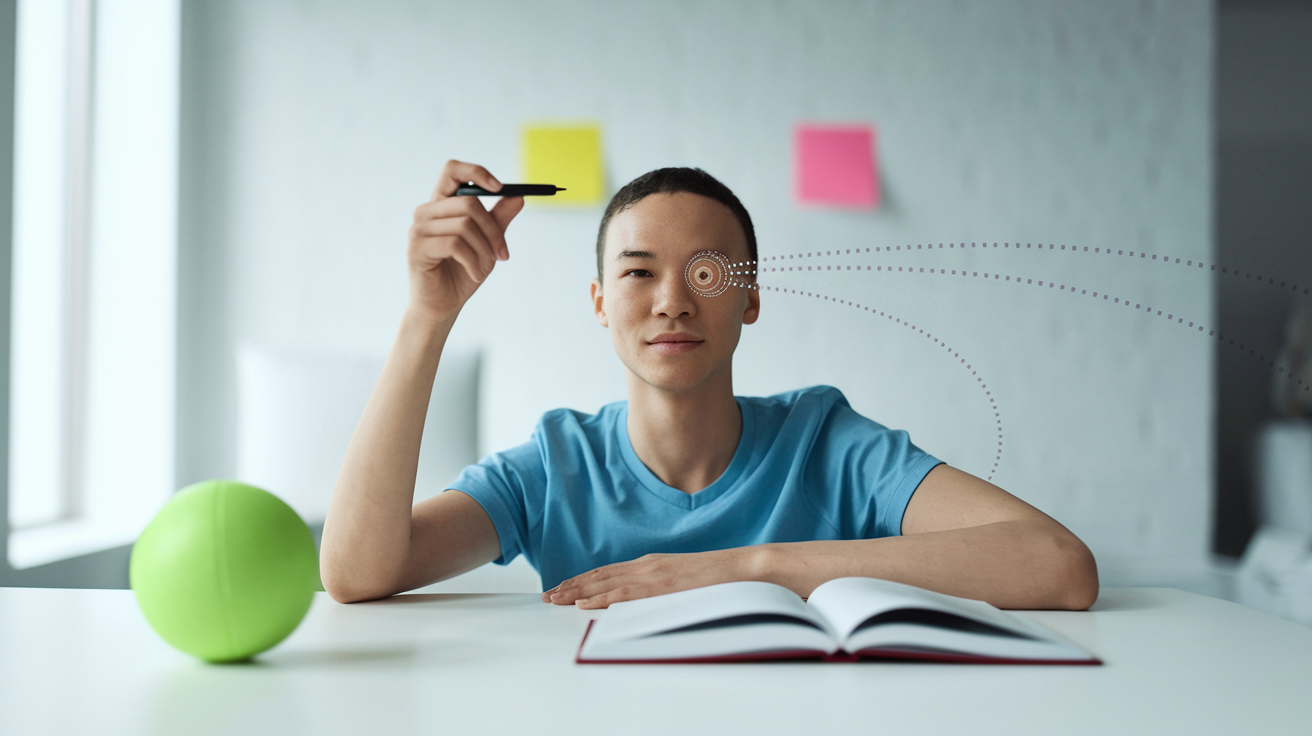
These five drills build on the basics already covered, giving you the full setup, reps, and progression for each. Do them in order, or pick the ones that match what you’re working on.
1. Pen pursuit
Hold a pen 30 to 40 cm from your face and move it slowly left to right, up and down, then in slow circles. Follow it with your eyes only, keeping your head steady but relaxed. Start with 1 minute and work up to 2 to 3 minutes as it gets easier. If the pen starts to blur or double, slow down before you speed up.
2. Saccade jumps
Pick two targets, maybe two sticky notes on a wall, spaced about 50 cm apart. Shift your gaze quickly from one to the other, trying to land precisely on each one rather than overshooting. Do 20 reps to start. Once that feels easy, add a third target and turn it into a triangle pattern.
3. Near-far focus shifts
Hold a small target (a pen tip works fine) at 20 to 30 cm from your eyes. Pick a second target across the room, maybe 3 to 6 meters out. Focus on the near one, then shift to the far one, then back again. That’s one rep. Do 10 to start, and don’t rush the transition, clarity matters more than speed here.
4. Catch and track
Toss a soft ball straight up and catch it, following it with your eyes the whole way. Once that’s comfortable, try bouncing it off a wall at an angle so you have to track a less predictable path. Start with 30 attempts. This one doubles as a decent warm-up for anyone doing sport-specific training.
5. Line tracing (reading-style saccades)
Take a page of text, any book or printout will do, and move your eyes line by line without using a finger to guide you. Time yourself, then reread the same page a few days later and compare. This drill is especially useful if you’ve noticed yourself losing your place while reading or skipping lines.
A few things apply across all five. Keep sessions short, 10 to 20 minutes total is plenty. Stop immediately if you get double vision, nausea, dizziness, eye pain, or a bad headache. And don’t chase speed before accuracy, a slow, clean pursuit is worth more than a fast, sloppy one.
If you’re not seeing progress after a few weeks of consistent practice, or something feels off, that’s worth bringing to an eye care professional rather than pushing through on your own.
Final Words
You tried a compact 10-minute routine that trains smooth pursuits and saccades: follow-a-pen, target shifts, near-far focus, a ball toss, and quick logging of accuracy and discomfort.
These simple drills help athletes, kids who lose their place while reading, adults doing supervised rehab, and older people who notice tracking slipping. Keep sessions short and stop if double vision, nausea, marked dizziness, eye pain, or a severe headache occurs.
To test how to improve visual tracking, do the routine for two weeks, track what changes, then tweak difficulty. Small, steady wins are very possible.
FAQ
Q: What causes poor visual tracking?
A: Poor visual tracking is caused by uncorrected vision, binocular mismatch or eye alignment issues, weak eye-movement control, fatigue, attention problems, developmental delays, or neurological injury — get a vision check and note patterns.
Q: Can eye tracking be improved?
A: Eye tracking can often be improved with short, regular drills (about 10–20 minutes daily), starting slow and increasing difficulty; measurable gains often show in 2–8 weeks unless a structural problem is present.
Q: Does ADHD cause eye tracking issues?
A: ADHD can cause eye tracking issues by reducing sustained attention and smooth scanning, leading to losing your place or more reading regressions; treating attention and trying focused drills may help.
Q: What does poor eye tracking look like?
A: Poor eye tracking looks like jerky eyes, losing a moving target, turning your head to follow things, skipping or rereading lines, slow reactions, or clumsy catching — track when it happens and seek help if sudden.