



What if machines can “see” more than we do, and still make confident mistakes?
Image pattern recognition is how computers spot visual patterns in pictures and decide what they mean.
A lot happens between a raw photo and a trusted label.
This post breaks that path into clear stages: capture, clean and normalize pixels, extract features, classify, and check confidence.
You’ll see how training teaches models to notice useful bits, which techniques suit messy real-world photos, and simple tests you can run to judge a system’s results.
From Pixels To A Checked Result
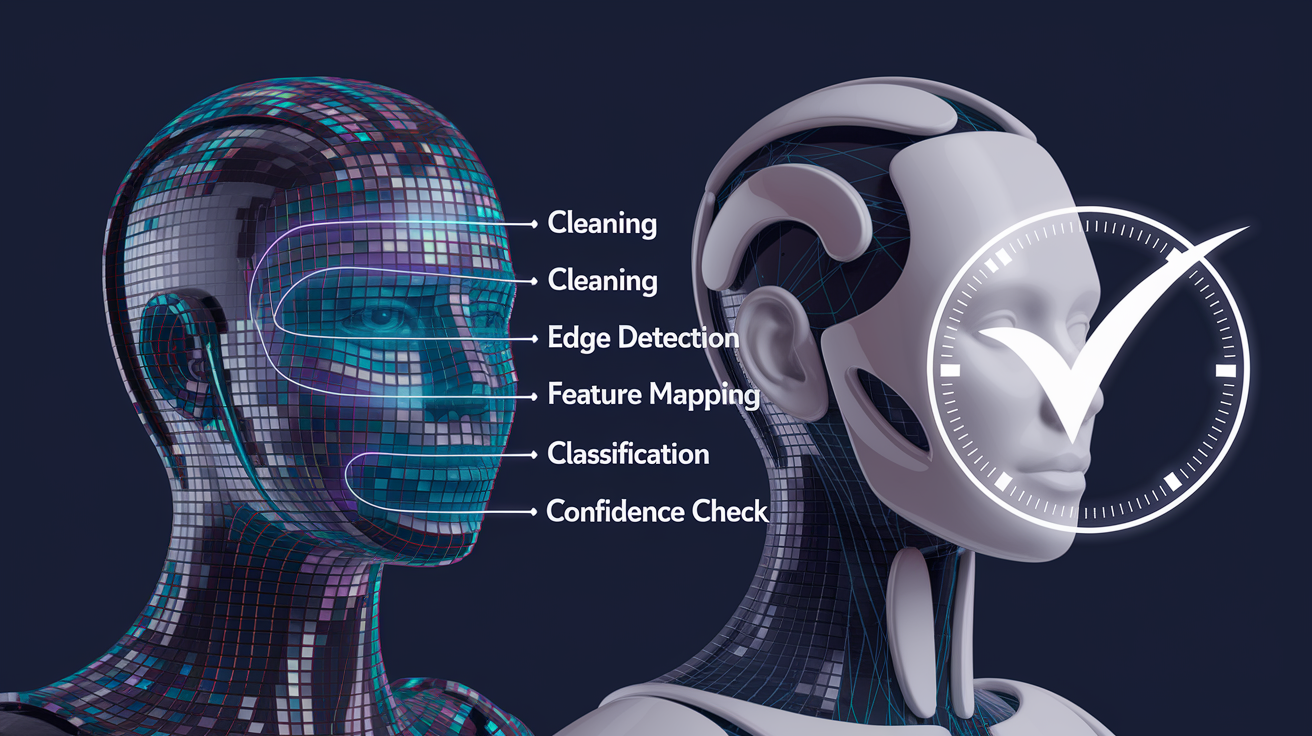
Image pattern recognition is how a computer spots visual patterns in a picture and figures out what they mean.
Sounds simple enough, but a lot happens between “here’s a photo” and “here’s what’s in it.” The path breaks down into five steps:
- Image acquisition: A camera, sensor, upload, or stream supplies the image.
- Preprocessing: The system cleans, resizes, normalizes, or otherwise preps the pixels.
- Feature extraction: An algorithm picks out useful visual properties, things like edges, textures, shapes, or learned patterns.
- Classification: A trained model compares those features against what it already learned and predicts a label.
- Output and confidence checking: The system hands back its result, often with a confidence score or threshold check attached.
None of this works without training first. Training is how a model figures out which visual features actually predict a given label. You feed it thousands of examples, and eventually it starts noticing the difference between, say, a cat’s ear and a dog’s ear on its own.
This whole process lives inside the bigger fields of computer vision and AI. Worth remembering that a single image or video frame can contain millions of pixel values. That’s a massive amount of raw data to sort through, and it’s exactly why simple fixed rules don’t cut it here. You need specialized algorithms built to find patterns humans would take forever to spot by hand.
The End-To-End Recognition Pipeline

Think of the recognition process as a relay race. Each stage takes what the last one handed off, does its job, and passes something new down the line. Here’s how that plays out across six stages.
-
Data acquisition: This is where it all starts. A physical scene or an existing visual source gets captured by a camera, sensor, upload, or stream. What comes out is a digital image or a sequence of frames. Quality matters a lot here, poor lighting, an awkward camera angle, low resolution, or a slow sampling rate can all hurt what the system has to work with later.
-
Preprocessing: The raw image goes through cleanup. Noise removal, distortion correction, resizing, normalization, filling in missing values, boosting contrast, reducing dimensionality, all of that happens here. What comes out is a cleaner, more consistent version of the image, ready for the next step.
-
Feature extraction and representation: The prepped image gets converted from raw pixels into something more meaningful, a feature vector or feature map. These features might be hand-crafted by an engineer, or learned automatically by the system itself. We’ll get into exactly how that works in the next section.
-
Classification: The extracted representation goes into a trained model or decision rule, which evaluates it and produces a predicted class, label, or score.
-
Post-processing: The initial prediction and its confidence scores get refined using thresholds, temporal smoothing, or business rules. This step exists mainly to cut down false positives, giving you a final result that’s been accepted, rejected, or adjusted.
-
Monitoring: Once live, the system’s predictions, feedback, and performance data get tracked over time. This stage watches for accuracy drops and shifts in the data itself, flagging when something needs review or retraining.
Different technical approaches handle the feature extraction and classification stages in pretty different ways. That’s what we’ll unpack next.
Core Techniques Used In Image Pattern Recognition
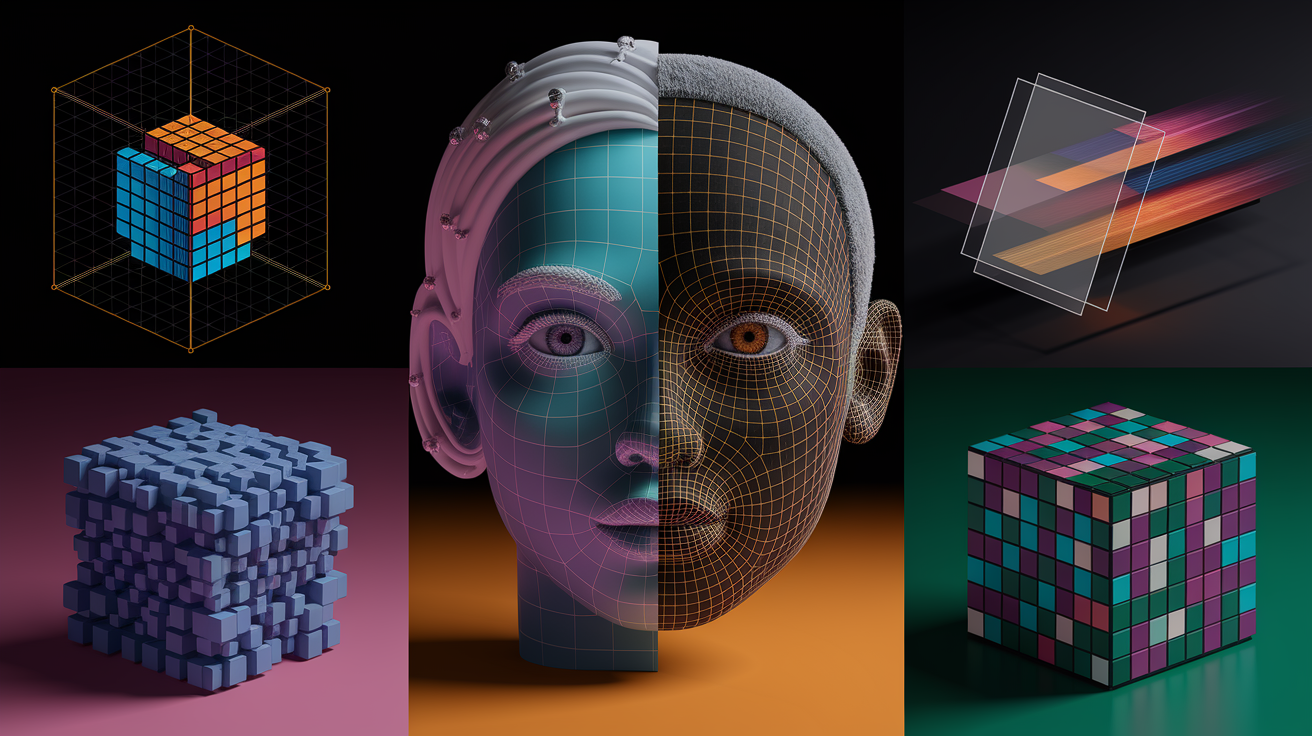
The five approaches below all try to solve the same problem, spotting structure in an image, but they go about it in very different ways. Some compare geometric measurements. Some learn rules. Some just study millions of examples until patterns emerge on their own.
Statistical Pattern Recognition
This approach treats an image as a point sitting somewhere in a multidimensional feature space, then draws geometric or probabilistic boundaries to separate one class from another. The features themselves are usually hand-crafted, meaning a person decided what to measure. Common examples include edges, textures, gradients, shapes, and keypoints, often captured through descriptors like SIFT, SURF, and HOG. These descriptors turn visual details into numbers a classifier can actually compare.
Syntactic Pattern Recognition
Instead of raw measurements, this method describes objects as structured arrangements of smaller parts, almost like a grammar for shapes. A face might get described as “two eyes above a nose above a mouth,” with rules defining how those parts relate. This works well for rigid or hierarchical structures where the pieces don’t move around much. The catch? As structures get more complex, the number of possible arrangements can grow fast, making it computationally expensive.
Template Matching
Here, a reference image or patch slides across the target image, and the system calculates a similarity score at each position. It’s straightforward and works well when conditions are controlled. But it’s also fragile, small changes in scale, rotation, viewpoint, or lighting can throw off the match entirely.
Neural Pattern Recognition
Rather than relying on manually chosen features, neural networks learn useful representations directly from training data. A convolutional neural network (CNN) does this in stages: convolutional layers detect local patterns like edges or corners, activation functions introduce the nonlinearity needed to model complex relationships, and pooling layers shrink the spatial size of the data while keeping the important information.
As the data moves through deeper layers, simple features combine into more complex structures, eventually letting the network recognize entire objects. Vision transformers offer an alternative architecture that’s gained ground in recent years, often matching or beating CNN performance on certain tasks.
Self-Supervised And Foundation Models
This newer approach lets a system learn visual representations from huge collections of unlabeled images before it’s ever adapted to a specific task. DINOv3, a 7 billion parameter vision transformer released in 2025, is a strong example. It performs well on segmentation, depth estimation, and keypoint matching, all without needing task-specific fine-tuning first.
| Technique | Best Suited For |
|---|---|
| Statistical pattern recognition | Tasks with clear, measurable features like edges or textures |
Final Words
In the action, we followed the path from raw pixels to a checked result, capture, preprocessing, feature extraction, classification, and output with confidence checks.
We mapped the full recognition pipeline, compared core approaches like statistical, syntactic, template, neural, and self-supervised methods, and covered how training data, augmentation, and monitoring shape reliable models.
If you still ask how does image pattern recognition work, think of it as a chain of small, testable steps that turn millions of pixels into useful labels. Try one simple experiment this week and watch what changes.
FAQ
Q: How to tell if you’re good at pattern recognition?
A: You can tell you’re good at pattern recognition by noticing when you spot recurring details, predict outcomes from small clues, learn shortcuts quickly, or consistently notice trends others miss.
Q: Can you explain pattern recognition in a simple way?
A: Pattern recognition is the brain or a computer noticing repeated arrangements, linking small cues to likely outcomes, and using past examples to predict or label new situations.
Q: Are people with ADHD good at pattern recognition?
A: People with ADHD may be strong at spotting novel or big-picture patterns, but may struggle with slow, detail-heavy tasks; strengths vary, so tracking when you notice patterns helps.
Q: Does pattern recognition mean high IQ?
A: Pattern recognition doesn’t necessarily mean high IQ; it’s one skill that aids thinking, but IQ tests measure many abilities, and practice or experience can improve pattern skills.