


Think you need a GPS watch or lab test to know if your training is too much or too little?
You don’t.
At home, the quickest, most useful signal is how hard a session felt, called session RPE, or rate of perceived exertion.
Multiply that RPE score by the minutes and you get a simple training-load number to track easily.
This post walks you through how to collect RPEs, add daily and weekly totals, and spot patterns that tell you when to push or back off.
No fancy gear, just consistent timing, small tests, and basic math.
Quick-Start Session-RPE Tracking
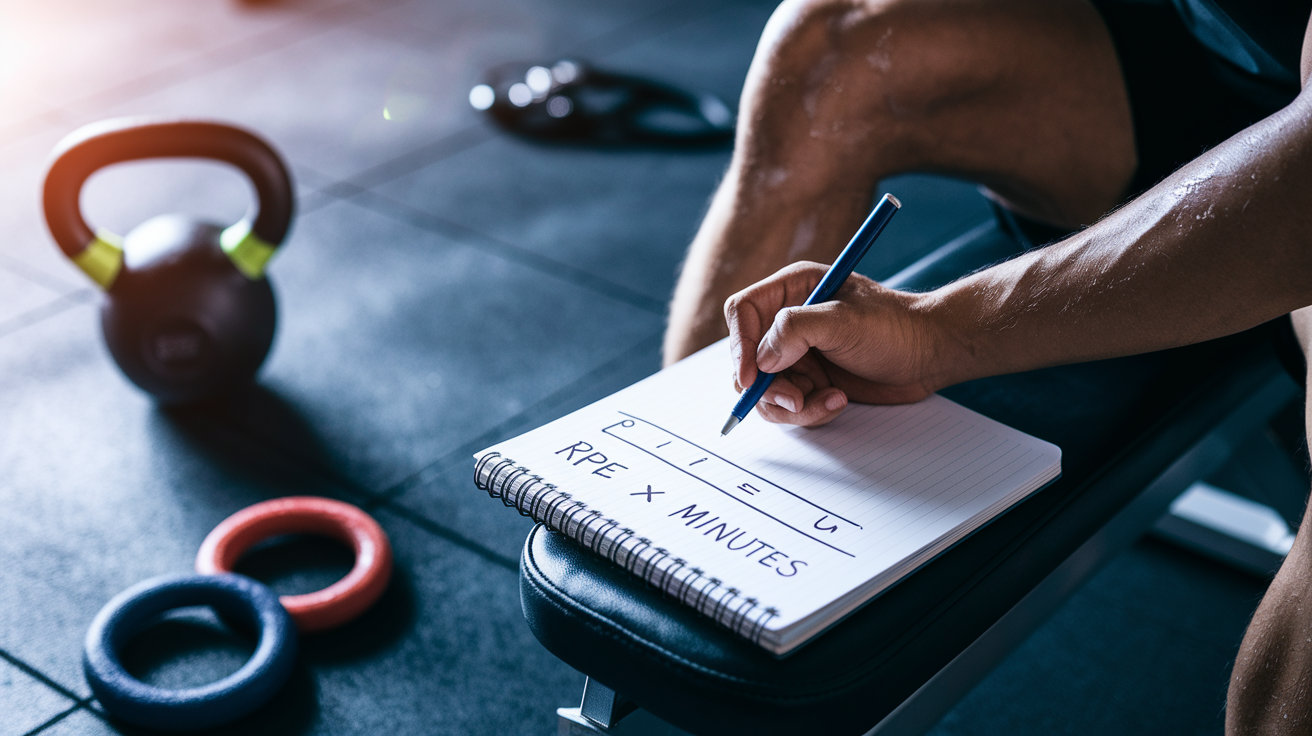
Internal load is what’s actually happening inside your body during training. It’s the heart racing, the lungs working, the legs burning. External load is the visible work itself, like distance covered, reps completed, or weight lifted (Impellizzeri et al., 2005). If you don’t have GPS units or lab equipment at home, internal load becomes your most practical starting point. And session RPE (rate of perceived exertion) is the easiest way to capture it.
The session-RPE calculation is simple. Multiply your RPE score (0 to 10) by your session duration in minutes. That gives you a number in arbitrary units, or AU. So if you rate a session a 6 out of 10 and it lasted 90 minutes, your session load is 6 × 90, which equals 540 AU. That single number represents your training stress for that session.
To rate your session, use these five grouped anchors:
- Rest (0): no exertion at all
- Easy (1 to 2): very, very easy to easy effort
- Moderate (3): noticeable but comfortable effort
- Hard (4 to 6): somewhat hard to hard effort
- Maximal (7 to 10): very hard to all-out effort
Write down your AU value after every session so you can start comparing days and weeks against each other.
Why Home-Based Load Tracking Has Practical Limits
Without GPS trackers or lab-based testing, you won’t get precise external-load numbers like sprint speed or total distance covered. That’s normal. Most people training at home end up leaning on internal-load measures like RPE instead, since they don’t require any special hardware.
That said, RPE has its own quirks. The timing of when you rate your effort matters, ratings can shift depending on how familiar you are with the scale, and training with a partner sometimes leads to copycat scores rather than honest ones. On the heart-rate side, chest straps tend to give more accurate beat-to-beat data, while wrist optical trackers are convenient but can lose accuracy during quick interval changes.
None of this means your data is useless though. What matters more than perfect precision is using the same method, under similar conditions, every time. That consistency is what lets you actually spot trends worth acting on.
Calculating Session-RPE And Daily/Weekly Training Load
Timing matters more than people realize when rating a session. Collecting your RPE score 10 to 20 minutes after you finish, rather than the second you stop, helps reduce recency bias. Without that gap, your rating often reflects only the last hard interval or the final few minutes, not the session as a whole.
CR10 Versus Borg 6-20
The CR10 scale runs from 0 to 10 and is the version most commonly used for session-RPE tracking today. It’s simple, quick to explain, and pairs naturally with the AU calculation covered earlier.
The Borg scale runs from 6 to 20 and has a longer history in exercise science research. It’s still used in some clinical and performance settings, but the numbers don’t translate directly to CR10 scores.
Either scale works fine for consistent tracking. What doesn’t work is switching between them. Pick one scale and stick with it whenever you’re comparing daily or weekly trends, so the numbers actually mean something over time.
Combining Multiple Sessions Into Daily And Weekly Totals
Some days include more than one training session, like a morning lift followed by an evening run, or a mobility session tacked onto a strength day. Each session gets its own RPE rating and its own session-load calculation. Once you have every session load for the day, add them together to get your daily total. Then add all seven daily totals across the week to get your weekly load.
| Day | Session(s) | Duration (min) | RPE | Session Load (AU) | Daily Total (AU) |
|---|---|---|---|---|---|
| Monday | Strength | 60 | 6 | 360 | 360 |
| Tuesday | Run | 40 | 5 | 200 | 200 |
| Wednesday | Strength + Mobility | 50 + 20 | 7 + 2 | 350 + 40 | 390 |
| Thursday | Rest | 0 | 0 | 0 | 0 |
| Friday | Intervals | 30 | 8 | 240 | 240 |
| Saturday | Long Run + Core | 70 + 15 | 6 + 3 | 420 + 45 | 465 |
| Sunday | Easy Walk | 30 | 2 | 60 | 60 |
| Weekly Total | 1715 | ||||
Once you have a few weeks of totals, compare them side by side. Just make sure every week uses the same RPE scale. Mixing CR10 and Borg scores will make your weekly comparisons meaningless.
Measuring Training Volume With Sets, Reps, And Weight
Session-RPE gives you internal load in arbitrary units, but it doesn’t tell you anything about the actual weight you moved. That’s where strength volume comes in. Vol
Final Words
In the action, you learned to separate internal load (how your body feels) from external load (distance, sets, weight) and to use session-RPE (RPE × minutes) to get an AU score.
We also covered timing your rating 10-20 minutes after the session, choosing one scale (CR10 or Borg), adding multiple sessions into daily and weekly totals, and calculating strength volume with sets × reps × weight.
Try logging session-RPE and volume this week to spot patterns. That’s a simple way to test how to measure training load at home. Small steps, useful insights, steady progress.
FAQ
Q: How do I calculate my training load?
A: You calculate training load by multiplying session RPE (0–10) by session duration in minutes. Example: RPE 6 × 90 minutes = 540 arbitrary units (AU). Sum sessions for daily and weekly totals.
Q: What is the 3-3-3 rule for strength training?
A: The 3-3-3 rule means you increase weight when you complete 3 sets of 3 reps across three consecutive workouts. It’s a simple progression check to add load safely and predictably.
Q: How many pushups should a 65 year old man be able to do?
A: A 65-year-old man commonly does about 0–15 push-ups; 8–12 is typical for moderately active people. Focus on steady progress with modified push-ups if needed and track changes over time.
Q: How does Apple measure training load?
A: Apple measures training load mainly from heart-rate data and workout duration, converting intensity and time into estimates of cardiovascular strain and active calories; accuracy improves with consistent wear and good sensors.